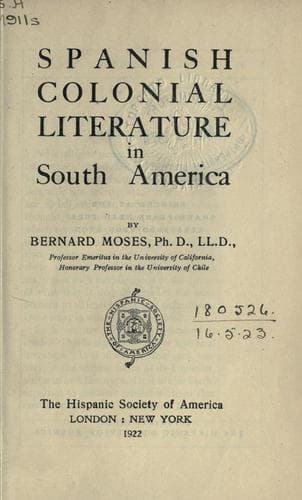
Spanish colonial literature in South AmericaMoses, Bernard
History
Spanish colonial literature in South America
Moses, Bernard
Spanish American literature -- History and criticism
“It is off Cubagua and Cumaná that pearl fishing is chiefly carried on,
as I have been fully informed by Indians and Christians, who say that
many Indians go from the island of Cubagua. These belong to crews in the
service of private persons, residents of Santo Domingo and San Juan. They
go out in a boat or barge in the morning, in companies of four, five, six
or more, and when it seems to them, or they know already, that there are
pearls at the point they have reached, they stop there, and the Indians
dive into the water and swim until they reach the bottom; one remains in
the boat, which he holds in place as well as he can, waiting for those in
the water to appear, and after the Indian has been down a long time, he
comes to the surface and is taken into the boat, presenting and putting
into it the oysters which he has brought up, for in the oysters are found
the valuable pearls. He rests a little, eats a mouthful, and then enters
the water again, and stays as long as he is able, and again comes up
with the oysters which he has found this time and does as before, and in
this manner all the rest proceed who are divers in this operation. And
when night comes, and it appears to be time to rest, they go home to the
island, and turn over the oysters to the major domo of the proprietor,
who has charge of the Indians, and who gives them their supper, and
places the oysters in a receptacle, and when he has a large number of
them, he causes them to be opened, and in them are found pearls of two,
three, four, five, six or more grains, as nature has placed them there.”
[Sidenote: Fate of fishers]
This quotation from Oviedo’s _Sumario_ offers a glimpse of an occupation,
which sooner or later proved fatal to immense numbers of the Indians
forced into it. Many of those engaged in pearl-fishing were compelled to
re-enter the water before they had recovered their normal condition after
a previous descent, and either never returned to the surface alive, or
returned hopelessly exhausted. But in connexion with this account our
author makes no mention of the perilous and destructive character of the
work, through which the population of the islands and the neighbouring
coast was greatly depleted. Doubtless Oviedo wished to reform abuses in
the colonies, but his relation to the court and his part in the public
administration naturally rendered him reluctant to make conspicuous in
his writings the abuses that were brought to his attention. The presence
of these abuses produced in his mind a very different reaction from that
observed in the fiery spirit of Las Casas.
The reference, in the _Brevísima relación_, to the pearl fishing
described by Oviedo reveals the contrast between Las Casas’ lively
sympathy with the Indians and Oviedo’s unconcern and official
indifference:
[Sidenote: Las Casas on pearl fishing]
Public-domain text, read in full here on John Shaqi.
Reviews
Reviews
No reviews yet
Be the first to share your thoughts on this work.
Join the Discussion
Join the discussion
Sign in to leave a comment or review.
Sign InorCreate an account