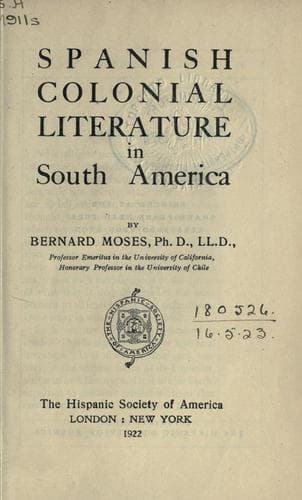
Spanish colonial literature in South AmericaMoses, Bernard
History
Spanish colonial literature in South America
Moses, Bernard
Spanish American literature -- History and criticism
“Having taken on board there bread and wine and other provisions, we
again set sail. At the end of eight days, on the 13th of September, 1556,
we entered the port of San Lucar de Barameda, and thence proceeded to
Seville. As soon as I was cleared, I went to Cadiz, and having embarked
in an urca, at the end of two months I reached Genoa, where I rejoiced
exceedingly, and soon afterwards arrived at Milan; always praising the
Majesty of God, His power, and that of our Saviour, for having granted me
the grace to see so many strange things, and so much of the world, and
so many foreign countries; and for having liberated me out of so many
serious trials. When I reflect, it seems to me impossible that a human
body could have undergone so much—_che un corpo humano habbia potuto
supportar tanto_.”
[Sidenote: Fernández’s _Relación_]
Juan Fernández’s _Relación_, dealing with the social disturbances of
Peru, after the death of Viceroy Antonio de Mendoza (1551-1552) and the
causes from which they proceeded is a clearly written and trustworthy
document, which remained unpublished until 1865. It is especially
valuable as a critical investigation of the principal causes and events
of Girón’s rebellion.[28] Its author was the fiscal of the audiencia of
Lima, and arrived in Peru either with Pedro de la Gasca or with Viceroy
Antonio de Mendoza, probably with the latter.
CHAPTER IV
PERUVIAN AND CHILEAN HISTORIANS, 1550-1600.
I. _José de Acosta._ II. _Garcilaso de la Vega._ III. _Pedro
Sarmiento de Gamboa; Polo de Ondegardo._ IV. _Cristóbal de
Molina; Cabello de Balboa._ V. _Pedro de Valdivia._ VI. _Alonso
de Góngora Marmolejo._ VII. _Pedro de Mariño de Lovera._
I
[Sidenote: Gasca’s work]
[Sidenote: Antonio de Mendoza & successors]
At the beginning of the second half of the sixteenth century a temporary
calm brooded over the affairs of Peru. President Gasca had allayed the
factional disturbances, but his administration, if it had produced
peace, had nevertheless brought little satisfaction to the contending
parties. A new attempt was now made to set up a viceroy. In the meantime
the audiencia controlled public affairs, but in 1551 Antonio de
Mendoza arrived in Lima as the viceroy of Peru. With the prestige of
his long reign in Mexico, he undertook the task of establishing order
in the unorganized colony, but he died the following year, leaving the
governmental authority again in the hands of the audiencia. In 1555
Andrés Hurtado de Mendoza accepted the vacant office, and a line of more
or less distinguished successors continued the viceregal administration
to the end of the century.[29]
[Sidenote: State of Lima]
Public-domain text, read in full here on John Shaqi.
Reviews
Reviews
No reviews yet
Be the first to share your thoughts on this work.
Elsewhere in the archive
Join the Discussion
Join the discussion
Sign in to leave a comment or review.
Sign InorCreate an account