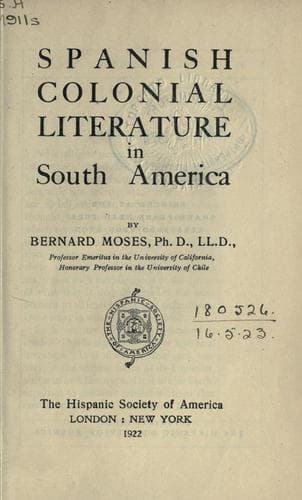
Spanish colonial literature in South AmericaMoses, Bernard
History
Spanish colonial literature in South America
Moses, Bernard
Spanish American literature -- History and criticism
During these decades the Peruvian government acquired its normal and
stable character, largely through the legislative activity of Viceroy
Francisco de Toledo. Lima gradually increased in population and acquired
many of the institutions which later characterized its social life,
such as the university, the tribunal of the Crusada, the inquisition,
and various monasteries. In the meantime the mines of Upper Peru,
particularly those of Potosí, continued to pour out their riches,
making Lima the market at which the precious metals were exchanged for
imported European wares. The increasing wealth was attended by a more
elaborate style of living, by the growth of more formal and refined
manners, by the multiplication of religious ceremonies, and by the rapid
acquisition of property by the Church. At the same time, as the creoles
in the population increased in numbers, they became conspicuous for their
ostentation, and, by departing from the severe manners and customs of the
Spaniards, added a certain lightness and freedom to social intercourse.
But in spite of the persistent call of these circumstances to practical
affairs, a number of persons appeared in the colony during this period,
who by their writings indicated that not all the world was absorbed
in contemplating the output of the mines, the gains of trade, or in
rivalling one another in the display of newly-acquired wealth. Some of
these by their office in the Church were expected to stand aloof, and
did stand aloof, from the ordinary economic activity of the community;
in fact, this period and the half-century following were especially
noteworthy for their literary production, both in Peru and in Chile.
[Sidenote: Acosta]
[Sidenote: Acosta with Toledo]
Public-domain text, read in full here on John Shaqi.
Reviews
Reviews
No reviews yet
Be the first to share your thoughts on this work.
Elsewhere in the archive
Join the Discussion
Join the discussion
Sign in to leave a comment or review.
Sign InorCreate an account