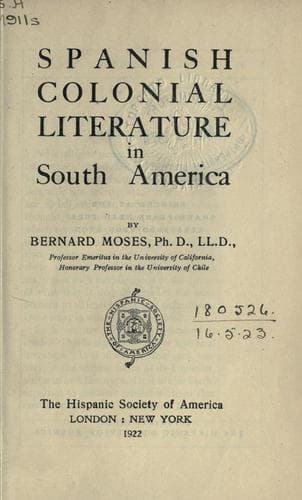
Spanish colonial literature in South AmericaMoses, Bernard
History
Spanish colonial literature in South America
Moses, Bernard
Spanish American literature -- History and criticism
In Peru José de Acosta, Garcilaso de la Vega, and Pedro Sarmiento became
especially prominent. These men were better equipped by education than
most of the writers who had described the events of the conquest from
personal observation. Acosta was a professor of theology in Lima, and
the Church expected to have its influence extended by his eloquence as
a preacher. His principal work is entitled _Historia natural y moral de
las Indias_. The first book deals chiefly with Peruvian affairs, but
the fifth, sixth and seventh books refer extensively to conditions and
institutions in Mexico. The author was born in Spain in 1540, and his
boyhood was passed with his parents in the town of Medina del Campo. He
became a Jesuit in 1553 and went to America in 1570. The intervening
years had been spent in study, so that when he set out for the Indies he
had already acquired a vast amount of knowledge. He landed at Cartagena,
went to Nombre de Dios and thence across the Isthmus to Panama. From
Panama he proceeded to Peru, and arrived at Callao in 1571. Peru was then
under the vigorous rule of Viceroy Francisco de Toledo (1569-1581), who
at this time was absent from Lima, engaged in making an inspection of the
viceroyalty. Acosta was ordered to join the viceroy’s other assistants,
particularly Polo de Ondegardo and Juan Matienzo. He accompanied Toledo,
and was a member of the expedition directed against the Chiriguana
Indians.
[Sidenote: Offices in Lima]
After his return to Lima he resumed his duties as professor of theology,
and retained this post until the middle of 1575, when he became rector
of the Colegio Máximo de San Pablo. The next year he was promoted to
the office of provincial of the Jesuit province of Peru, succeeding the
first provincial, Portillo. Acosta’s term as provincial expired in 1580.
He resided for some years at the missionary station of Juli, near Lake
Titicaca, and during this period his time was divided between missionary
work and writing. The Jesuits had established a college at Juli to
facilitate the study of the native languages. Holguín had resided there,
and his Quichua grammar is an important contribution to knowledge of that
language. Bertonio, also sometime a resident there, performed a similar
service by his Aymará dictionary.
[Sidenote: Acosta at Council of Lima]
Public-domain text, read in full here on John Shaqi.
Reviews
Reviews
No reviews yet
Be the first to share your thoughts on this work.
Elsewhere in the archive
Join the Discussion
Join the discussion
Sign in to leave a comment or review.
Sign InorCreate an account