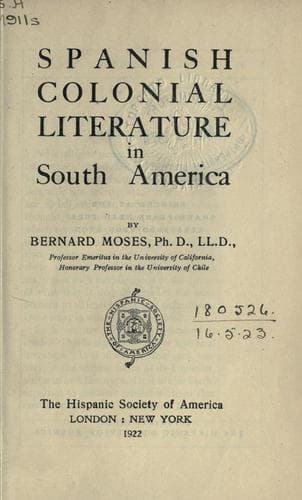
Spanish colonial literature in South AmericaMoses, Bernard
History
Spanish colonial literature in South America
Moses, Bernard
Spanish American literature -- History and criticism
Acosta removed from Upper Peru to Lima near the end of Toledo’s reign.
The viceroy’s administration, through his prolific and generally wise
legislative activity, contributed greatly to the orderly establishment
of the viceroyalty, but by his unjust condemnation and execution of the
Inca he incurred the displeasure of the king, and died in disgrace.
Under Martín Enríquez (1581-1586) Toledo’s successor, was held the third
ecclesiastical Council of Lima. At the last sitting Acosta delivered what
has been characterized as “an elegant and learned oration”; he also wrote
the history of the council. At this council he was theological adviser,
and was appointed to edit the acts of the council.
A little later Acosta went to Mexico, where after a short sojourn,
covering the year 1586, he returned to Spain in 1587 taking with him for
publication various manuscripts written by him during the fifteen years
of his residence in America. He was in Madrid in 1588, and in this year
he began the publication of the work on which his reputation as a writer
chiefly rests, his _Historia natural y moral de las Indias_. The complete
work under this title was, however, not published until 1590, the date of
the Seville edition.[30]
[Sidenote: _Historia natural y moral_]
The first four books treat of the natural history of the Indies. Of these
the first and second were written in Latin, while Acosta was in Peru, and
were translated into Spanish by him after his return to Spain, where
all the rest of the work was written. The fifth, sixth and seventh books
contain what the author calls the moral history of the Indies, embracing
such subjects as are involved in the organization and development of
society.
The numerous editions of this work indicate somewhat the strength of the
early demand for information regarding America. Large numbers of persons
were solicitous to know about the climate and its fitness for securing
human health; the metals, plants, and animals; the rites and ceremonies
of the inhabitants; the laws and government; and the wars with the
Indians. The nature of the contents of the work suggested the designation
of the author as the Pliny of the New World.
After an extensive discussion of the views held by ancient writers,
sacred and profane, concerning the geography and the natural phenomena of
the Indies, Acosta touches on the project of cutting a canal across the
Isthmus. He wrote:
[Sidenote: Acosta on a Panama canal]
Public-domain text, read in full here on John Shaqi.
Reviews
Reviews
No reviews yet
Be the first to share your thoughts on this work.
Elsewhere in the archive
Join the Discussion
Join the discussion
Sign in to leave a comment or review.
Sign InorCreate an account