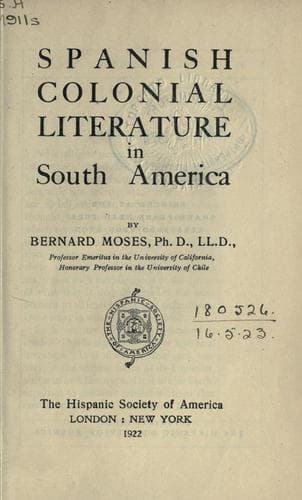
Spanish colonial literature in South AmericaMoses, Bernard
History
Spanish colonial literature in South America
Moses, Bernard
Spanish American literature -- History and criticism
“Some have discoursed and propounded to cut through this passage of
seven leagues, and to joyne one sea to the other, to make the passage
from Peru more commodious and easie, for that those eighteen leagues of
land betwixt Nombre de Dios and Panama is more painfull and chargeable
than two thousand and three hundred by sea, whereupon some would say it
were a means to drowne the land, one sea being lower than another. As
in times past we finde it written, that for the same consideration they
gave over the enterprise to win the Red Sea with the Nile, in the time
of King Sesostris, and since, in the Empire of the Ottomans. But for my
part, I hold such discourses and propositions for vaine, although this
inconvenient should not happen, the which I will not hold for assured,
I believe there is no humane power able to beat and breake downe those
strong and impenetrable mountains, which God hath placed betwixt the two
seas, and hath made them most hard rockes, to withstand the furie of two
seas. And although it were possible to men, yet in my opinion they should
feare punishment from heaven in seeking to correct the workes which the
Creator by his great providence hath Ordained and disposed in the forming
of this universall world.”[31]
[Sidenote: Food products]
Among the food-products described, Acosta makes mention of the potato,
saying that “The Indians use another kinde of roote, which they call
Papas. These rootes are like the ground nuttes; they are small rootes
that cast out many leaves. They gather the Papas, and dry it well in the
Sunne, then beating it they make that which they call _Chuñu_, which
keeps many daies, and serves for bread. In this realme there is great
trafficke of _Chuñu_, the which they carry to the mines of Potosí; they
likewise eat of these Papas boyled or roasted. There is one sweete kinde
which grows in hot places, whereof they do make certain sauces and minced
meats which they call _Locro_.”[32]
In writing of coca, Acosta calls attention to an article, the use of
which under the Indian régime was subject to severe restrictions,
enforced by a religious sanction, but since then these restrictions have
been removed, with many of the evil consequences that were doubtless
feared by the paternal government of the Incas:
[Sidenote: Acosta on coca]
Public-domain text, read in full here on John Shaqi.
Reviews
Reviews
No reviews yet
Be the first to share your thoughts on this work.
Elsewhere in the archive
Join the Discussion
Join the discussion
Sign in to leave a comment or review.
Sign InorCreate an account