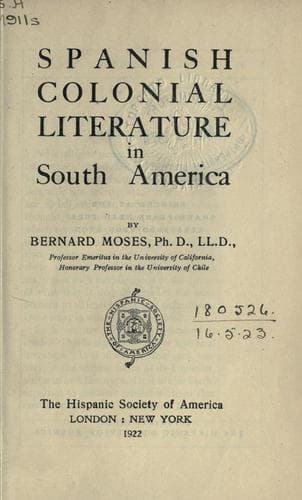
Spanish colonial literature in South AmericaMoses, Bernard
History
Spanish colonial literature in South America
Moses, Bernard
Spanish American literature -- History and criticism
“The Indians esteeme it much, and in time of their Kings Yncas it was
not lawfull for any of the common people to use this coca without
licence from the governor. Their use is to carry it in their mouthes,
chawing it and sucking out the juyce, but they swallow it not. They
say it gives them great courage, and is very pleasing unto them. Many
grave men holde this as a superstition and a mere imagination; for my
part, and to speak the truth, I perswade not my selfe that it is an
imagination but contrariwise, I thinke it works and gives force and
courage to the Indians; for we see the effects which cannot be attributed
to imagination, as to go some daies without meat, but only a handfull of
coca, and other like effects.”[33]
II
[Sidenote: Garcilaso de la Vega]
[Sidenote: Parents of Garcilaso]
By his ancestry Garcilaso de la Vega was connected with some of the most
distinguished families of Spain, the families of Mendoza and Vargas.
His father was the son of Alonso de Hinestrosa de Vargas, whose wife
was Blanca Suárez de Figueroa, a descendant of that Garcilaso de la
Vega on whom the name was originally conferred for his famous duel with
the gigantic Moor on the Vega of Granada. This name was adopted by the
historian’s father as that of a maternal ancestor. The son of Hinestrosa
de Vargas thus became Garcilaso de la Vega. This Garcilaso de la Vega
was born in the city of Badajoz in Estremadura in 1506. At the age of
twenty-five, in 1531, he went to America as a captain of infantry, at
the time of Pedro de Alvarado’s return to resume the government of
Guatemala. He became a member of Alvarado’s ill-fated expedition to
Quito, that landed at Caraques in March, 1534. After Alvarado’s surrender
to Almagro, Garcilaso de la Vega entered the service of Pizarro, and was
sent to subdue the natives about the port of Buenaventura. Owing to the
difficulties of the march and the loss of a large part of his men he was
obliged to abandon the undertaking. He then went to Lima, where he found
Pizarro besieged by the Indians. His next service was in the campaign for
the relief of Cuzco, that appeared to be in danger of falling into the
hands of the insurgent natives.
[Sidenote: Garcilaso the elder]
Public-domain text, read in full here on John Shaqi.
Reviews
Reviews
No reviews yet
Be the first to share your thoughts on this work.
Elsewhere in the archive
Join the Discussion
Join the discussion
Sign in to leave a comment or review.
Sign InorCreate an account