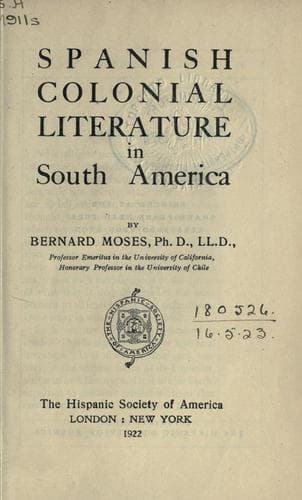
Spanish colonial literature in South AmericaMoses, Bernard
History
Spanish colonial literature in South America
Moses, Bernard
Spanish American literature -- History and criticism
Another phase of the viceroy’s activity was the setting up of the
viceregal establishment, where the vice-queen presided, and introduced
much of the ceremonious life of a European Court. At this time the
question of the aims and ambitions of the Incarial family began to
excite inquiry if not alarm, and the prominence of this subject induced
Sarmiento to study seriously the history of the Incas. This subject
claimed his attention for a number of years after his arrival in Lima.
But during his residence at the capital he was persecuted by the
Inquisition. The charges against him were trivial, and for one alleged
offence he was condemned to the absurd punishment of hearing mass in
the cathedral at Lima, divested of his clothing and holding a candle in
his hand. In addition to this penalty, it was ordered that he should be
perpetually banished from the Indies. But by appealing to the Pope he
was released from the penalty of banishment, and permitted to reside
in Cuzco and other parts of Peru until 1567. Still, this senseless
persecution was continued until his public services obtained for him the
protection of the government.
[Illustration: Page 2 of the MS. of Pedro Sarmiento de Gamboa]
[Sidenote: _Segunda parte de la historia general_]
During these ten years he made various journeys throughout the country
in pursuit of information concerning the Incas. Of the results of these
investigations there remains _Segunda parte de la historia general
llamada índica_. Other parts, if any others were written, have not come
to light. The manuscript of this second part includes a dedication to
the king that was written at Cuzco and signed by Sarmiento on March 4,
1572. The work as designed by the author was to consist of three parts.
The second, and apparently the only part written, contains the history
of the Incas. It treats of the early rulers of Peru and their principal
officers, the settlement of Cuzco, the legends concerning the origin
of the Incas, the entrance of Manco Capac into the region of Cuzco,
the subsequent wars with other tribes, the reigns of Tupac Yupanqui
and Huayna Capac, and the civil wars between Huascar and Atahualpa, of
which the Spaniards took advantage on their arrival in Peru. Sarmiento
fixes the beginning of the Inca dynasty at the year 565, thus making its
continuance a little less than a thousand years.[40]
[Sidenote: Continued persecution]
[Sidenote: Sarmiento pursues Drake]
[Sidenote: Voyage to the Strait]
[Sidenote: Thomas Cavendish]
Public-domain text, read in full here on John Shaqi.
Reviews
Reviews
No reviews yet
Be the first to share your thoughts on this work.
Elsewhere in the archive
Join the Discussion
Join the discussion
Sign in to leave a comment or review.
Sign InorCreate an account