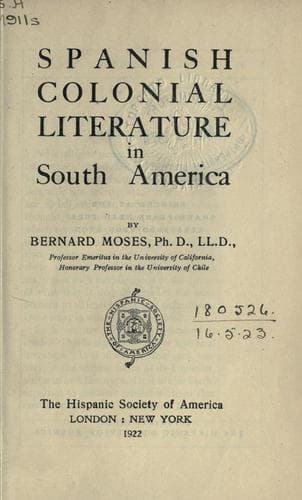
Spanish colonial literature in South AmericaMoses, Bernard
History
Spanish colonial literature in South America
Moses, Bernard
Spanish American literature -- History and criticism
A further contribution to the history of the Inca kingdom was made
by Pedro Sarmiento, who not only held a high place among the Spanish
navigators of the sixteenth century but also merits consideration among
the writers of his time. He was born at Alcalá de Henares about 1532. His
father was Bartolomé Sarmiento, a native of Pontevedra in Galicia, whose
wife was of a Biscayan family named Gamboa. Pedro passed the period of
his childhood and youth in his father’s house at Pontevedra, near the
little port of Bayona; but at the age of eighteen he entered the military
service of Spain, and was a soldier from 1550 to 1555, when he succumbed
to the desire to seek adventures and fortune in America. His sojourn
in Mexico and Guatemala left no important record in the history of the
period. In 1557 he arrived in Peru, then under the rule of Viceroy
Andrés Hurtado de Mendoza, Marqués de Cañete, who had made his solemn
entry into Lima on June 29, 1556.
[Sidenote: Social unrest and sedition]
The rebellions of Gonzalo Pizarro and Girón had been put down, but the
spirit of discontent and hostility to the government was manifest in many
quarters. The judges of the audiencia were leaders of opposing factions;
the corregidores were supporting practically independent military forces,
and their unlawful acts imposed intolerable burdens on persons subject to
their authority. Everywhere there were smouldering embers of sedition.
The viceroy faced this condition of affairs with a grim determination to
bring peace to the troubled society. He gathered and held subject to his
order the arms and munitions that were scattered among the corregidores.
The prominent disturbers of the peace he disarmed and sent into exile.
He caused Tomás Vásquez, the lieutenant of Girón, to be executed, and
ordered the corregidores to impose the same punishment upon turbulent and
dangerous persons within their districts. And to furnish a vent to the
restlessness of adventurers, he encouraged the organization of exploring
expeditions, of which the most notorious was that of Pedro de Ursúa, that
finally fell under the control of the brutal Lope de Aguirre.
[Sidenote: The viceregal court]
[Sidenote: Persecution of Sarmiento]
Public-domain text, read in full here on John Shaqi.
Reviews
Reviews
No reviews yet
Be the first to share your thoughts on this work.
Elsewhere in the archive
Join the Discussion
Join the discussion
Sign in to leave a comment or review.
Sign InorCreate an account