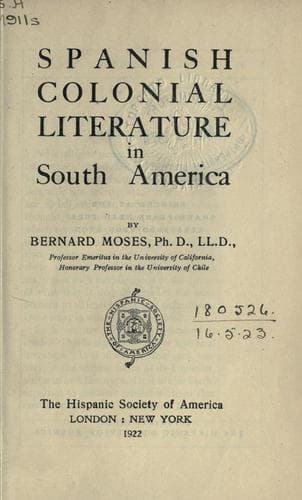
Spanish colonial literature in South AmericaMoses, Bernard
History
Spanish colonial literature in South America
Moses, Bernard
Spanish American literature -- History and criticism
In a subsequent chapter Sarmiento refers to Pizarro’s project to inquire
into the dispute between Huascar and Atahualpa: “Don Francisco Pizarro
knew of the disputes there had been between Atahualpa and Huascar, and
that Huascar was a prisoner in the hands of the captains of Atahualpa,
and he urged Atahualpa to have his brother brought as quickly as
possible. Huascar was being brought to Caxamarca by Atahualpa’s order,
as has already been said. Chalco Chima, obeying this order, set out with
Huascar and the captains and relations who had escaped the butchery of
Cusi Yupanqui. Atahualpa asked Don Francisco Pizarro why he wanted to see
his brother. Pizarro replied that he had been informed that Huascar was
the elder and principal lord of that land, and for that reason he wished
to see him, and he desired that he should come. Atahualpa feared that if
Huascar came alive, the Governor Don Francisco Pizarro would be informed
of what had taken place, that Huascar would be made lord, and that he
would lose his state. Being sagacious, he agreed to comply with Pizarro’s
demand, but sent off a messenger to the captain who was bringing Huascar
with an order to kill him and all the prisoners. The messenger started
and found Huascar at Atamarca, near Yana-mayu. He gave his message to the
captain of the guard who was bringing Huascar as a prisoner.
[Sidenote: Fate of Huascar]
“Directly the captain heard the order of Atahualpa he complied with it.
He killed Huascar, cut the body up and threw it into the river Yana-mayu.
He also killed the rest of the brothers, relations, and captains who were
with him as prisoners, in the year 1533.”[43]
[Sidenote: Polo de Ondegardo]
A noted contemporary of Sarmiento, the Licenciado Polo de Ondegardo, also
became interested in the history of Peru and the ancient institutions of
the country, and, at the suggestion of the viceroy, wrote two accounts,
or “relaciones,” on the revenues and tributes, or, in general, the
financial administration of the Inca kingdom.
The time and place of Ondegardo’s birth are not known. It has been
ascertained, however, that he was in Peru during the period of the civil
wars. By Gasca he was appointed governor of Charcas, and he held for a
number of years a similar office at Cuzco, to which he was appointed by
the Marqués de Cañete as viceroy. Under Francisco de Toledo, Ondegardo
was a confidential adviser of the viceroy, and assisted him in drawing up
the ordinances for completing the organization of the viceroyalty.
[Sidenote: Prescott on Ondegardo]
Public-domain text, read in full here on John Shaqi.
Reviews
Reviews
No reviews yet
Be the first to share your thoughts on this work.
Elsewhere in the archive
Join the Discussion
Join the discussion
Sign in to leave a comment or review.
Sign InorCreate an account