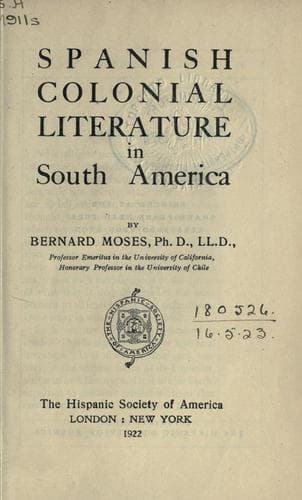
Spanish colonial literature in South AmericaMoses, Bernard
History
Spanish colonial literature in South America
Moses, Bernard
Spanish American literature -- History and criticism
Prescott, who had copies of Ondegardo’s narratives, affirms that while
he gives his conclusions with an air of modesty, it is evident that
he feels conscious of having derived his information through the most
authentic channels. He rejects the fabulous with disdain; decides on
the probability of such facts as he relates, and candidly exposes
deficiency of evidence. Far from displaying the simple enthusiasm of the
well-meaning but credulous missionary, he proceeds with the cool and
cautious step of a lawyer, accustomed to the conflict of testimony and
the uncertainty of oral tradition. This circumspect manner of proceeding
and the temperate character of his judgments entitle Ondegardo to much
higher consideration as an authority than most of his countrymen who have
treated of Indian antiquities. But his part in the intellectual life
of Peru was not limited to his inquiries into Indian antiquities; his
considerable contribution to Toledo’s extensive legislation entitles him
to a place among the writers on law and government, although no formal
political treatise by him has appeared in print.
These papers remained long in manuscript, but a translation of one
of them was printed in the Hakluyt Society’s volume of narratives of
the rites and laws of the Incas. The following brief extract is from
Ondegardo’s account of the origin of the Inca kingdom:
[Sidenote: Ondegardo quoted]
“It is enough to understand that these Yncas at first extended their
conquests by violence and war. There was no general opposition to their
advance, for each province merely defended its land without aid from
any other, so that the only difficulty encountered by the Yncas was in
the annexation of the districts forming Cuzco. Afterwards the conquered
people joined them, so that they always had a vastly superior force as
well as more cunning in the art of war.”[44]
A little farther on in his report, Ondegardo describes the organization
of the districts within the limits of the Inca’s jurisdiction:
“As soon as the Yncas had made themselves lords of a province, they
caused the natives, who had previously been widely scattered, to live
in communities, with an officer over ten, another over every hundred,
another over every thousand, another over every ten thousand, and an
Ynca governor over all, who reported upon the administration every
year, recording the births and the deaths that had occurred among men
and flocks, the yield of the crops, and all other details, with great
minuteness. They left Cuzco every year, and returned in February to make
their report, before the festival of Kaymi began, bringing with them the
tribute of the whole empire. This system was advantageous and good, and
it was most important in maintaining the authority of the Yncas. Every
governor, how great lord soever he might be, entered Cuzco with a burden
on his back. This was a ceremony that was never dispensed with, as it
gave great authority to the Yncas.”[45]
IV
Public-domain text, read in full here on John Shaqi.
Reviews
Reviews
No reviews yet
Be the first to share your thoughts on this work.
Elsewhere in the archive
Join the Discussion
Join the discussion
Sign in to leave a comment or review.
Sign InorCreate an account