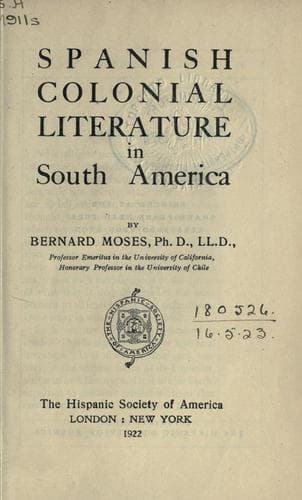
Spanish colonial literature in South AmericaMoses, Bernard
History
Spanish colonial literature in South America
Moses, Bernard
Spanish American literature -- History and criticism
In the Jesuit Bartolomé de Escobar Lovera found a person who was able to
supplement his work where his literary deficiencies were most evident.
In some places Escobar wrote in his own name, or in the first person.
While smoothing the rough places in the soldier’s composition, he added
as adornments of style references to Biblical history and to the history
of the Greeks and the Romans. The simple credulity of Lovera, moreover,
led him to accept as miracles many events presented in tales by imposters
or by persons of exaggerated faith. Santiago mounted on a white horse and
fighting for the Spaniards on the plains of Chile, as one of the stock
visions, had naturally to be introduced; perhaps also the view of the
Virgin taking up a handful of dust from the ground and throwing it into
the faces of the Indians to blind them during the combat. But there were
certain rare inventions that also found place in Lovera’s pages, as when
to the members of the war council of the Indians there appeared ‘una
gran señora’ placed in mid-air, who reprimanded them for their crimes,
infidelity, and blindness. The view of this figure caused them to hang
their heads in silence for half an hour, and then “to depart each for
his own house.”[54] These and other miraculous episodes of the book are
ascribed in large measure to the influence of the pious Escobar. The
latest personal note in the _Crónica_ relating to Lovera is found in his
vivid account of the earthquake of December 16, 1575, which follows:
[Sidenote: On the earthquake of 1575]
[Sidenote: The tidal wave]
Public-domain text, read in full here on John Shaqi.
Reviews
Reviews
No reviews yet
Be the first to share your thoughts on this work.
Elsewhere in the archive
Join the Discussion
Join the discussion
Sign in to leave a comment or review.
Sign InorCreate an account