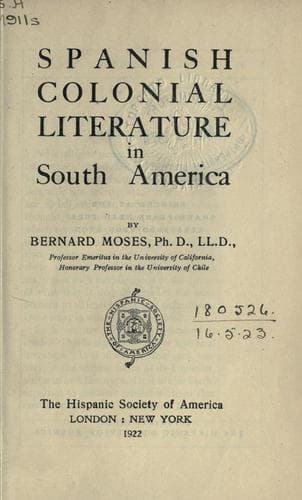
Spanish colonial literature in South AmericaMoses, Bernard
History
Spanish colonial literature in South America
Moses, Bernard
Spanish American literature -- History and criticism
“Jerónimo de Alderete having arrived in Spain to negotiate with his
Majesty in the name of Pedro de Valdivia, it became necessary for him to
go to England, since the emperor, Charles V, had renounced his authority
in all his kingdoms in favour of his Serene Highness, Prince Philip,
his son, and retired into a monastery of monks; he was not concerning
himself with affairs under any circumstances; whence Alderete had to go
to England to see the king, who on account of having married the queen of
England was in that country. Having arrived there, and the king, having
been informed of his coming, after a few days conferred the government of
Chile upon Valdivia for life, and furthermore provided that the person
whom he might nominate should succeed him. With this order Alderete left
England; on entering France he was overtaken by a messenger, sent by
Eraso, secretary to the king, who informed him that by letters the king
had learned that Valdivia was dead, and it appeared to Alderete that he
ought to return and take up his negotiations.... Having received this
news, Alderete returned to London, where the king was; on account of the
good mediators whom he had, and by the good opinion which the king held
of him, the king showed him the favour of giving him the government of
Chile, as Valdivia had had it, and also conferred upon him the order of
Santiago and the title of adelantado. Having received these favours, he
left Spain for Chile. After he reached Panama, which is, and has been,
the cemetery of Christians, he fell very seriously ill with a fever, and
died.”[53]
VII
[Sidenote: Pedro Mariño Lovera]
[Sidenote: Lovera and Escobar]
Another Chilean soldier who turned to literary work after a stormy life
in the army was Pedro Mariño de Lovera. His _Crónica del reino de
Chile_ was the product of his later years. He was born in Pontevedra,
in Galicia, where his father, Herrán Rodríguez de Lovera, was a life
member of the municipal council. Having served for a period in the army,
he yielded to the desire for a voyage to the Indies, which he undertook
in 1545. From Nombre de Dios he determined to return to Spain, but at
Havana he met Pedro de la Gasca, then on his outward voyage to assume
the presidency of Peru. The result of this interview was the sending of
Lovera with an important charge to Antonio de Mendoza, the viceroy of
Mexico. This service was performed so satisfactorily that when Mendoza
was transferred to the viceroyalty of Peru, in 1551, Lovera accompanied
him to Lima. Here he appears to have intended to establish himself,
but his restless spirit urged him on to Chile, then presenting, in the
Araucanian wars, abundant opportunities for adventure. After his sojourn
in Chile, he returned to Lima. He was in Lima in 1594, and it was in this
later period that he gathered up his notes and wrote his chronicle of
Chile.
[Illustration: Francisco de Villagra]
[Sidenote: Lovera’s credulity]
Public-domain text, read in full here on John Shaqi.
Reviews
Reviews
No reviews yet
Be the first to share your thoughts on this work.
Elsewhere in the archive
Join the Discussion
Join the discussion
Sign in to leave a comment or review.
Sign InorCreate an account