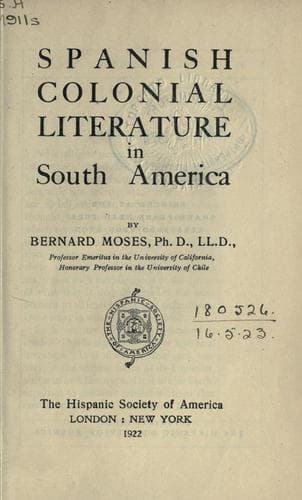
Spanish colonial literature in South AmericaMoses, Bernard
History
Spanish colonial literature in South America
Moses, Bernard
Spanish American literature -- History and criticism
In Chile Ercilla found himself under conditions sharply in contrast
with those of his life in Spain. A site had been selected for the town
of Santiago, and plots had been assigned to soldier-colonists; but
fourteen years after the arrival of Valdivia the Spanish occupation was
represented only by a number of garrisoned posts confronting a region
in possession of vigorous and hostile Indians. Ercilla had exchanged
the circumstances of the artificial life of the Spanish court for
warfare with a barbarous people in the presence of primitive nature. To
a Spaniard of the sixteenth century an excursion beyond the limits of
civilization, into the realm of savage life, was a stranger event than
a similar experience would appear to a representative of these later
generations. In the unfamiliar presence of primitive man and the primeval
forest Ercilla was moved to set down his impressions of the life in which
he had part, and of the nature that constituted his strange environment.
[Sidenote: Ercilla condemned]
Ercilla’s relation to the commander of the expedition had its unpleasant
episodes. On the occasion of a dispute between him and Juan de Pineda,
the supporters of each of the two parties drew their swords, when García
de Mendoza interpreted the movement as the beginning of a mutiny, and
condemned the two opponents to be beheaded. The activity of their
friends, however, caused these ill-advised sentences to be commuted to
imprisonment.[57] After his liberation from prison Ercilla continued his
exploring expeditions and his participation in campaigns against the
Araucanians, but he finally returned to Spain in 1562. Shortly after
his arrival, having made a report to the king concerning his service in
Chile, he went to Austria, where his mother held the position of a maid
of honour at the imperial court. Returning from this journey in 1564, he
remained a number of years in Madrid and published there the first part
of _La Araucana_ in 1569. The next year he married Doña María de Bazán,
and in 1571 the king bestowed upon him the order of Santiago.
[Illustration: Page from the First Edition of “La Araucana”]
[Sidenote: Ercilla in Italy]
Determined to seek further service, he went to Italy in 1574, to join
the fleet, commanded by Don John of Austria, designed to proceed to
the relief of Tunis, but before he arrived in Naples, Tunis had fallen
into the hands of the Turks. At Rome he met one of his relatives, Juan
de Zúñiga, then Spanish ambassador near the papal court. On a fourth
journey to Austria he was graciously received by Emperor Maximilian and
by the empress, María; also by his godfather, Rudolph, who had become
king of Hungary. Ercilla returned to Spain in 1577. This was the last of
his journeys into foreign countries. In 1578 he published at Madrid the
second part of _La Araucana_.
[Sidenote: The argument]
The argument of the poem is stated in the first two octaves:
Public-domain text, read in full here on John Shaqi.
Reviews
Reviews
No reviews yet
Be the first to share your thoughts on this work.
Elsewhere in the archive
Join the Discussion
Join the discussion
Sign in to leave a comment or review.
Sign InorCreate an account