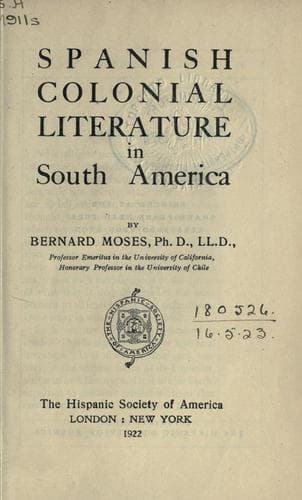
Spanish colonial literature in South AmericaMoses, Bernard
History
Spanish colonial literature in South America
Moses, Bernard
Spanish American literature -- History and criticism
No las damas, amor, no gentilezas
De caballeros canto enamorados;
Ni las muestras, regalos, y ternezas
De amorosos afectos y cuidados:
Mas el valor, los hechos, las proezas
De aquellos españoles esforzados,
Que a la cerviz de Arauco, no domada,
Pusieron duro yugo por la espada.
Cosas diré también harto notables
De gente que a ningún rey obedecen,
Temerarias empresas memorables
Que celebrarse con razón merecen;
Raras industrias, términos loables
Que más los españoles engrandecen;
Pues no es el vencedor más estimado
De aquello en que el vencido es reputado.[58]
[Sidenote: Spain against Portugal]
Soon after this publication the king sent Ercilla to Saragossa to confer
there with the Duke of Brunswick and to persuade him to postpone his
visit to Madrid. At the same time the question of the succession to the
Portuguese crown seemed to portend war, and Ercilla looked forward to
playing a conspicuous rôle in the projected campaign, and to celebrating
once more in verse the glory of Spanish arms. But the opposition to
Spain’s pretensions collapsed, and Portugal was annexed to Spain without
exploits worthy of heroic song. The poet turned from literary work
to religious devotion and prayer, and his tendency to melancholy was
intensified in his last years by the loss of his brother, Juan, who was
accompanying Philip II. to Portugal, and by the death of his only son,
Diego. Somewhat of this attitude of mind finds expression in the last
octave of his poem:
Y yo que tan sin rienda al mundo he dado
El tiempo de mi vida más florido,
Y siempre por camino despeñado
Mis vanas esperanzas he seguido;
Visto ya el poco fruto que he sacado,
Y lo mucho que a Dios tengo ofendido,
Conociendo mi error, de aquí adelante
Será razón que llore y que no cante.[59]
[Sidenote: The poet’s mental depression]
This mental depression had also a cause in the withdrawal of the king’s
favour as well as in the loss of relatives and friends and the fact that
the poet faced old age without descendants.
In 1589 Ercilla published the third part of _La Araucana_. Some years
later a new edition was issued, with two additional cantos, making the
whole number thirty-seven.[60] He died in the city of Madrid on the
29th of November, 1594. The statement sometimes made that he died in
extreme poverty does not appear to be supported by the fact that at
the time of his death he had a household establishment consisting of
twelve persons, to whom he bequeathed considerable sums, but with the
statement that these sums were moderate, since all of these persons were
expected to remain in the service of his widow, and derive advantage from
her liberality. Among other bequests were five thousand ducats to his
nieces and nephews, and ten thousand ducats as a contribution for the
construction of a monastery, where his body and that of his widow might
be buried.
[Sidenote: The writing of the poem]
Public-domain text, read in full here on John Shaqi.
Reviews
Reviews
No reviews yet
Be the first to share your thoughts on this work.
Elsewhere in the archive
Join the Discussion
Join the discussion
Sign in to leave a comment or review.
Sign InorCreate an account