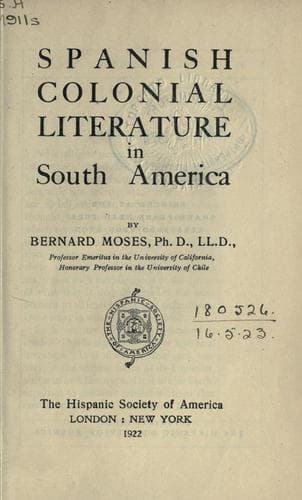
Spanish colonial literature in South AmericaMoses, Bernard
History
Spanish colonial literature in South America
Moses, Bernard
Spanish American literature -- History and criticism
A criticism of the style of _La Araucana_ is hardly involved in the
purpose of the present writing. Concerning this subject reliance must
be placed on the judgment of Spanish critics, by whom one will find the
excellences and defects of Ercilla’s verses sufficiently emphasized.
There are stretches of dull and loose narration, but here and there
are spirited verses, and octaves as fine as any found elsewhere in the
Spanish language; but in this age of rapid movement, in these days of
social impatience, three hundred and forty years after its publication,
the reading of the poem is likely to be confined to persons who on
account of their nationality or for other reasons have a special interest
in the romantic history of the Spanish conquest in Chile. It is on its
quality as history that stress must be laid. “Ercilla,” to quote a French
critic, “n’était qu’un historien fourvoyé dans la poésie.... Il manquait
surtout de sensibilité, de tendresse, pour mieux dire, et c’est selon
nous, la grande cause de son infériorité. Il ne parait avoir ressenti
vivement que l’ivresse brutale des combats. Il quitte la patrie sans
un soupir, il la retrouve sans un transport. Il n’a fait parler ni
l’amour paternel, ni l’amour filial. Les amants et les époux qu’il met en
scène sont des raisonneurs froids, sententieux et subtils, et s’il leur
échappe par hasard un cri passionné nous y percevons l’écho d’une plainte
antique.”[67]
In his _Retórica poética_, Barros Arana affirms that Ercilla “describes
with ardour” the combats and naturally and correctly the localities,
sketches regularly the characters, and puts beautiful speeches into
the mouth of his heroes, but his work lacks the plan and the necessary
unity of an epic to such a degree that instead of a poem it appears as a
poetical history of the war it celebrates.[68]
[Sidenote: Popularity of the poem]
But in spite of its shortcomings there are few books that have been
oftener printed, and, like the other great modern historical poems, it
has enjoyed a very noteworthy popularity. Even in recent times new and
popular editions have appeared, and in the last half of the nineteenth
century Alexandre Nicolas translated it into French prose, published
at Paris in two volumes in 1869. It had already been translated into
German by C. M. Winterling thirty-eight years earlier. An abridged
translation into French, by Gilibert de Merlhiac, appeared in 1824.
The metrical translation of parts of the poem into English, published
in the translation of Molina’s _Historia de Chile_ (Middletown, Conn.,
1808) hardly merits comment. The most striking success of the poem was
achieved in Chile, where the people, ignorant of all the favourable and
unfavourable contentions of the critics, have regarded it as their Iliad,
celebrating the beginning of their national life.
[Sidenote: _Hechos de Don García_]
[Sidenote: Character of Figueroa’s book]
[Sidenote: Life of Figueroa]
Public-domain text, read in full here on John Shaqi.
Reviews
Reviews
No reviews yet
Be the first to share your thoughts on this work.
Elsewhere in the archive
Join the Discussion
Join the discussion
Sign in to leave a comment or review.
Sign InorCreate an account