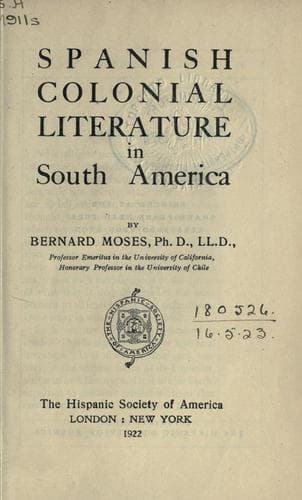
Spanish colonial literature in South AmericaMoses, Bernard
History
Spanish colonial literature in South America
Moses, Bernard
Spanish American literature -- History and criticism
Ercilla presents the Araucanian heroes speaking to their countrymen as
Spaniards might have spoken under similar circumstances. Evidently his
knowledge of them was too superficial to enable him to set forth their
psychological peculiarities, but he makes their individuality distinct by
descriptions of their dress. His lack of intimate knowledge of the Indian
mind may be indicated by the fact that apart from geographical terms he
uses few words of a local origin or meaning, or that might not have been
understood in Spain before the discovery of America. It is not merely
descriptions of dress or of persons that certain critics have found
admirable, but descriptions of events, of battles, as well. Considering
this quality, however, there has existed a wide divergence of judgments,
and the extreme unevenness of the poem suggests that some feature of it
may be found to justify each view. The course of the narrative is here
and there interrupted by the introduction of rhetorical speeches, and by
reflections that seem to embody a philosophy or views of life, and these
views indicate an uncheerful, if not a pessimistic, philosophy. In the
fourth octave of the second canto he announces that “the most assured
benefit of fortune is not to have ever had it”; and in the first octave
of the twenty-sixth canto he finds that “the coming of one good after
another is very doubtful, while one evil after another is always certain.
The time of prosperity was never lasting, and the time of misery has
never ceased.” This mournful note recurs frequently throughout the poem
until the final lamentation of the last octave.
[Sidenote: Barbarian innocence]
But in certain passages there are anticipations of the doctrine that
prevailed in France two hundred years later, the doctrine of the
uncorrupted virtue of uncivilized society. This octave, the thirteenth of
the thirty-sixth canto, is an indication:
La sincera bondad y la caricia
De la sencilla gente de estas tierras
Daban bien a entender que la codicia
Aún no había penetrado aquellas sierras;
Ni la maldad, el robo y la injusticia
(Alimento ordinario de las guerras)
Entrada en esta parte habían hallado
Ni la ley natural inficionado.[65]
[Sidenote: _Orlando Furioso_]
The marked attention given to _Orlando Furioso_ in Spain in the sixteenth
century made inevitable its influence on Ercilla. This poem was twice
translated into Spanish verse in the year 1549-1550, by Jerónimo de
Urrea and Hernando de Alcocer, and later a prose translation was made by
Vázquez de Contreras.
Seven editions of Urrea’s translation were issued before 1564, and
Ariosto appears to have been a principal source of Ercilla’s inspiration,
but the vigorous and positive spirit of the Spaniard was not able to
acquire the Italian’s gifts of facility, grace, and fancy.[66]
[Sidenote: Style of _La Araucana_]
[Sidenote: A view of Ercilla]
Public-domain text, read in full here on John Shaqi.
Reviews
Reviews
No reviews yet
Be the first to share your thoughts on this work.
Elsewhere in the archive
Join the Discussion
Join the discussion
Sign in to leave a comment or review.
Sign InorCreate an account