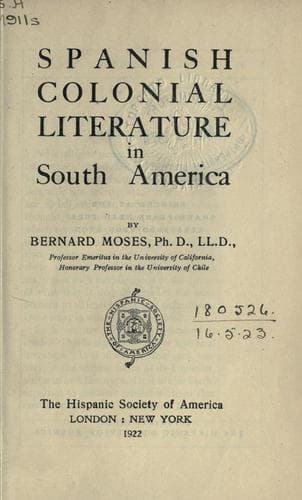
Spanish colonial literature in South AmericaMoses, Bernard
History
Spanish colonial literature in South America
Moses, Bernard
Spanish American literature -- History and criticism
The model set by Ercilla in _La Araucana_ was followed by later writers.
Pedro de Oña acknowledged that he was an imitator of Ercilla, and in
_Arauco domado_ he wrote of essentially the same series of events, events
of the Araucanian war; but the two writers emphasized different phases of
their subject. Ercilla celebrated the heroism of the Indians, and devoted
little attention to the Spanish governor, who was at the same time the
commander of the expedition against the Araucanians; Oña’s hero, on the
other hand, was García Hurtado de Mendoza, the governor of Chile, who
had become viceroy of Peru. García de Mendoza’s administration of Chile
had fallen in the most critical period of the province. In the beginning
of 1560 he was recalled from Chile by Philip II, and returned to Spain,
where he apparently outlived the disfavour of the crown; for in 1590 he
was sent back to America as viceroy of Peru. He was accompanied by his
brilliant wife, Doña Teresa de Castro, who took fifty women with her to
the capital. This year Oña took up his residence at the University of
San Marcos,[70] and his youthful and inexperienced mind was profoundly
impressed by the glories of the viceregal court. He was greatly moved
by the contrast it presented to the circumstances of his boyhood on
the Chilean frontier, where the Indians were not counted as heroes but
as savages against whom one had constantly to be defended. At Lima,
the centre of Spanish life in South America, recalling the unpleasant
circumstances of his early youth, it was natural that the dominant
note of his poem should be a glorification of the Spanish leader, then
occupying the exalted position of viceroy.
[Illustration: PEDRO DE OÑA]
[Sidenote: Oña’s education]
Public-domain text, read in full here on John Shaqi.
Reviews
Reviews
No reviews yet
Be the first to share your thoughts on this work.
Elsewhere in the archive
Join the Discussion
Join the discussion
Sign in to leave a comment or review.
Sign InorCreate an account