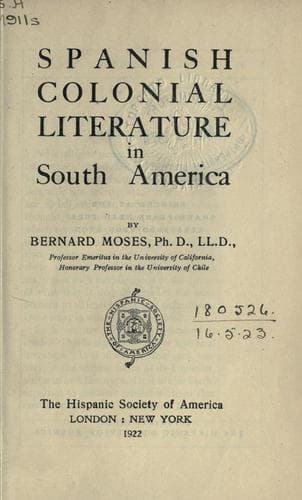
Spanish colonial literature in South AmericaMoses, Bernard
History
Spanish colonial literature in South America
Moses, Bernard
Spanish American literature -- History and criticism
Pedro de Oña was the first native Chilean to achieve distinction in the
literature of his country. He was born in the town of Valdivia, when
it was merely a frontier post, garrisoned by about forty soldiers. He
was the eldest son of Captain Gregorio de Oña, who was a member of the
garrison. The exact date of his birth is not known, but it belongs to
the decade between 1560 and 1570. There appears to be no record stating
the place where his childhood and youth were passed, or what were the
circumstances of his early education. But on August 8, 1590, he was
matriculated in the university of San Marcos in Lima. He must have had
elsewhere preparatory instruction, for the entry in the university books
is that he was matriculated for the “Primer de Artes,” took the oath of
obedience to the rector, and presented certificates of examination. The
next year he matriculated for the second course, and in 1592 for the
third course. In the absence of any later matriculation in the arts it is
presumed that he left the university with the degree of bachelor. He then
appears among the troops sent to put down an insurrection that had broken
out in Quito. After his return from this expedition he was matriculated
in 1593 for the first course in theology, but it is not known how far he
pursued his theological studies. Three years later, in 1596, he published
in Lima the _Primera parte del Arauco domado_, and on the title page he
sets himself down as “Licenciado.” This was two years after Ercilla’s
death.
[Sidenote: _Arauco domado_]
The writer of _Arauco domado_, like Ercilla, not only narrated real
events in the history of the conquest, but also introduced episodes
that were the products of his imagination, and all were presented with
a noteworthy facility of versification. But the real events of which
Oña was able to treat did not in his time justify the term “domado” in
his title. The historian Olivares affirms that Arauco may be said to
be _domado_ only in desire, since neither in Oña’s time, nor for two
hundred years later had all the power of Spain been able to effect the
subjugation.[71] And Oña’s treatment of the events in the process of this
war of subjugation was cut short at the close of the first part of his
poem, for the announced second part never appeared.[72]
[Sidenote: Mental attitude of Oña]
Public-domain text, read in full here on John Shaqi.
Reviews
Reviews
No reviews yet
Be the first to share your thoughts on this work.
Elsewhere in the archive
Join the Discussion
Join the discussion
Sign in to leave a comment or review.
Sign InorCreate an account