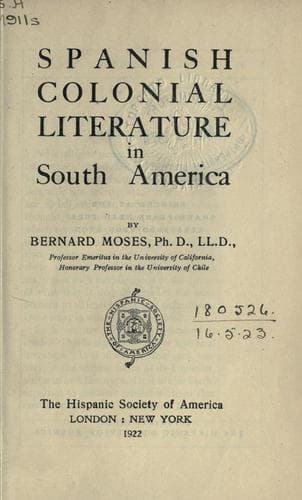
Spanish colonial literature in South AmericaMoses, Bernard
History
Spanish colonial literature in South America
Moses, Bernard
Spanish American literature -- History and criticism
After a long period, during which the name of Oña had passed from public
notice, there appeared in Seville in 1639 a poem by him entitled _El
Ignacio de Cantabra_, celebrating the founder of the Jesuits, and setting
forth the supernatural events which the poet’s fancy associated with
the spiritual life of his hero. At the same time the author gives some
account of the miracles that justified Ignacio’s designation as a saint,
and presents certain theological dissertations. The action of the poem
is clogged by the numerous descriptions of Ignacio’s spiritual views
and torments, and the poem itself is overloaded with the narration of
events that involve supernatural beings. This later work indicates that
with advancing years religious ideas became gradually the prepossession
of Oña’s mind. It shows, moreover, that he had effected a radical
change in his system of versification. The verses of his first work ran
without difficulty and without apparent effort, but in the last the
writer weighed every phrase, sought for transpositions however violent
they might be, parodied the poetic style, and polished his stanzas for
fifteen years.[74] The poem appears not to have had a second edition, but
it is said to have contributed much to enhance and confirm the poet’s
reputation in Europe.
II
In the course of his investigations in the National Library in Madrid
Barros Arana brought to light a poem in manuscript, belonging to the
class of historical narrative poems already considered. There is in the
manuscript no indication of the name of the writer, but it has been
ascribed to Juan de Mendoza Monteagudo. The poem is divided into eleven
cantos, containing a total of about eight thousand lines. It deals with
the events and the period treated by Ercilla, the wars between the
Spaniards and the Araucanians; it is written in the form of verse used in
_La Araucana_.
[Sidenote: Mendoza’s subject]
Here is the author’s announcement of his subject:
La guerra envejecida y larga canto,
Tan grave, tan prolija y tan pesada
Que a un reino poderoso y rico tanto
Le tiene la cerviz ya quebrantada.
Y en el discurso de ella también cuanto
Han hecho memorable por la espada
Aquellos que a despecho del estado
El gran valor de Arauco han sustentado.
Los casos contaré más señalados
En el discurso desto acontecidos
Entre los españoles no cansados
Y los rebeldes indios invencios.[75]
III
[Sidenote: Toledo with Sotomayor’s expedition]
Public-domain text, read in full here on John Shaqi.
Reviews
Reviews
No reviews yet
Be the first to share your thoughts on this work.
Elsewhere in the archive
Join the Discussion
Join the discussion
Sign in to leave a comment or review.
Sign InorCreate an account