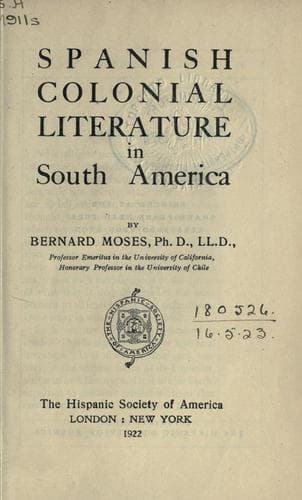
Spanish colonial literature in South AmericaMoses, Bernard
History
Spanish colonial literature in South America
Moses, Bernard
Spanish American literature -- History and criticism
Oña shared the religious views of the bulk of his countrymen; in fact,
the only persons who showed a disposition to break with the Church were
the encomenderos, when they found the priests intervening to modify
their treatment of the Indians. But Oña’s devoutness was only such as
conformed to the current sentiments of the more or less cultivated
colonists. It was a phase of Spanish patriotism and presumed hostility
to the English heretics. It presumed also that those who fell in
conflict with the English, whatever may have been the real origin of the
combat, fell in a holy cause. Another item in the mental furniture of
Oña and those like him was “the dogma of royal majesty,” which involved
attachment and devotion to the king of Spain, and ascribed to him all
the virtues, and especially love for his subjects, in spite of his
mental and moral incapacity and his subjection to corrupt favourites. It
involved devotion, service, and sacrifice to an ideal that became farther
and farther removed from the reality as one Spanish monarch succeeded
another throughout the last half of the sixteenth and the whole of the
seventeenth century. Proceeding from an author in this attitude of mind,
the poem naturally became a very serious production, not defiled by any
breath of humour.
[Sidenote: _Río Lima al río Tibre_]
A later work of Pedro de Oña which has come to light appeared in
connexion with the celebration of the designation of the Blessed
Francisco Solano as patron of the city of Santiago. It is entitled _Río
Lima al río Tibre_. This poem was printed in the beginning of Alonso
Mendieta’s edition of Diego de Córdoba’s _Vida, virtudes y milagros del
Apóstol del Perú, el V. P. Fray Francisco Solano_, which was published
in Madrid in 1643. It is based on the account of Francisco Solano set
forth in Córdoba’s _Vida_, and other material drawn from the early
history of the western coast of South America. Medina indicated his
appreciation of it by printing it in the text of his _Historia de la
literatura colonial de Chile_, and designating it as the most interesting
of the author’s poems. And the poet himself he characterized as “without
doubt the greatest Chilean poet of the colonial period.” At the end of
his elaborate account he pronounces a general judgment of the man and
his work: “As a man, the remembrance of his kindness, his simple and
honourable character, his love of his country and family cannot but
awaken profound sympathy; and as a poet the verses of _Arauco domado_ are
destined to be remembered under their double aspect of history and of
literature.”[73]
[Sidenote: _El Ignacio de Cantabra_]
[Sidenote: Quality of _El Ignacio_]
Public-domain text, read in full here on John Shaqi.
Reviews
Reviews
No reviews yet
Be the first to share your thoughts on this work.
Elsewhere in the archive
Join the Discussion
Join the discussion
Sign in to leave a comment or review.
Sign InorCreate an account