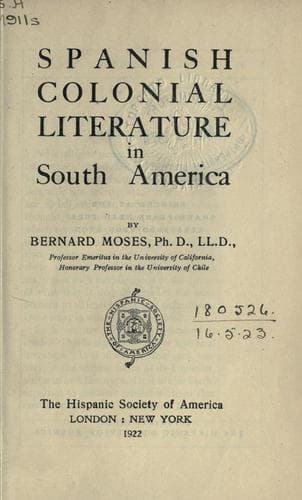
Spanish colonial literature in South AmericaMoses, Bernard
History
Spanish colonial literature in South America
Moses, Bernard
Spanish American literature -- History and criticism
After his arrival in Chile Toledo’s time was so distributed that war,
agriculture, and poetry each claimed a share. He became an alcalde of
Chillán, acquired extensive lands stocked with sheep and cattle, and
at least on one occasion he suffered the not uncommon experience of
having his estate plundered, his cattle driven off, and his herdsmen and
shepherds captured. This loss naturally inflamed his desire to see the
campaigns against the Indians carried on with energy, and added zeal to
his own participation. In one attack he was felled by a blow on the head
that caused him to be unconscious for an hour, and to remain for a period
without any recollection of the events of the conflict. Later he was
engaged in the battle of Yumbel, a detailed account of which he has given
in his writings.
[Sidenote: Cavendish rescues Fernando]
[Sidenote: Cavendish’s men betrayed by Fernando]
Holding the rank of captain, Álvarez de Toledo had part in numerous
encounters with the Indians. He appeared also in the conflict between
Cavendish’s men and the Spaniards on the coast of Chile. In passing
through the strait of Magellan Cavendish discovered the moribund remnant
of the colony Sarmiento had left in that inhospitable region, and took on
board one of the colonists named Fernando in order that he might serve
as a guide. Fernando finally betrayed the English, in spite of “all his
deepe and damnable othes which he had made continually to our general and
all his company never to forsake him, to die on his side before he would
be false;”[77] for when Cavendish landed fifty or sixty men on the coast
of Chile, at the bay of Quintero, in search of wood, Fernando led them
into a position where they were surprised and attacked by two hundred
Spaniards. Before Cavendish’s men were able to regain their ships,
twelve of them were killed by the Spaniards. That Fernando was held
as a prisoner by heretics has been advanced as a justification of his
deception, in spite of the fact that his removal from the settlement by
the strait saved his life. Toledo, who was one of the two hundred members
of the attacking party, has celebrated the event in his _Araucana_.[78]
[Sidenote: Toledo and the Indians]
Governor Alonso de Sotomayor appointed Toledo high constable in 1590. In
this period the tranquility of the Spanish settlers was greatly disturbed
by renewed hostilities on the part of the Araucanians, whose raids were
extended into regions that had been occupied by towns and villages of
Europeans. Toledo was alcalde of Chillán when that city was plundered and
destroyed by the cacique Quilacán in 1599. On this occasion Toledo was
absent, and to this fact is probably due the preservation of his life.
Public-domain text, read in full here on John Shaqi.
Reviews
Reviews
No reviews yet
Be the first to share your thoughts on this work.
Elsewhere in the archive
Join the Discussion
Join the discussion
Sign in to leave a comment or review.
Sign InorCreate an account