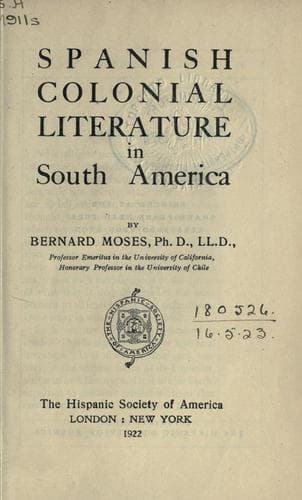
Spanish colonial literature in South AmericaMoses, Bernard
History
Spanish colonial literature in South America
Moses, Bernard
Spanish American literature -- History and criticism
After he had recovered from the shock caused by the news of this
disaster, he hastened to Chillán and joined a force that went in pursuit
of the Indians, under the command of Tomás de Olaverría, and was later
engaged in other campaigns. In 1600 Álvarez de Toledo married Jerónima de
Lemos. At that time he was living as an encomendero, or the proprietor,
of an estate in the country near San Juan de la Frontera, where he died
on August 3, 1633, leaving his estancia stocked with goats, sheep, and
cattle. Other items of his property were three slaves and a vineyard
inherited from his ancestors.
[Sidenote: Toledo’s _Araucana_]
[Sidenote: _El Purén indómito_]
Of Toledo’s poem _Araucana_ only small fragments have been preserved, and
the writer’s reputation rests chiefly on the twenty-four cantos of _El
Purén indómito_, written at least in part during the author’s military
service. It lacks most of the essential qualities of a poem but is
important as an historical document.[79]
Medina characterizes Álvarez de Toledo as simply a soldier who wrote
verses with great facility, and who, without any pretension to divine
inspiration, sets forth in an agreeable manner the conflict of arms
in which he himself had figured, or of which he had received minute
information from the accounts of his companions, narrated at night
around camp fires. He did not propose to present poetic inventions,
episodes of the imagination, but to recount only real and accredited
facts.[80] His purpose was to write a chronicle in verse, and the product
of his labour lacks the chief characteristics of an epic. In his fifteen
thousand lines the scene changes from Chile to Peru, from Santiago to
Concepción, from the banks of rivers to the sombre depths of the forests
of Arauco, and from the strand of the open sea to the narrow valleys of
the mountains; and throughout the narrative there is abundant evidence
of the writer’s memory of details, of the names of persons, of the exact
time of events, and even of the colour of horses. Some of his octaves
are composed almost entirely of names, and are therefore, practically
unreadable, particularly when these names are of Araucanian persons or
objects.[81]
The _Araucana_ of Álvarez de Toledo is accepted as a credible historical
narrative, and equal credibility is attributed to its continuation under
the title of _Purén indómito_.
IV
[Sidenote: Ercilla continued by Osorio]
Public-domain text, read in full here on John Shaqi.
Reviews
Reviews
No reviews yet
Be the first to share your thoughts on this work.
Elsewhere in the archive
Join the Discussion
Join the discussion
Sign in to leave a comment or review.
Sign InorCreate an account