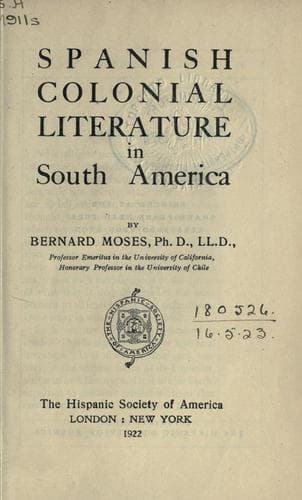
Spanish colonial literature in South AmericaMoses, Bernard
History
Spanish colonial literature in South America
Moses, Bernard
Spanish American literature -- History and criticism
The parts in print until recently were three parts of the _Elegías de
varones ilustres de Indias_ and the _Historia_. The first part treats of
the discovery of the New World, together with the conquest of certain
islands and a part of Tierra Firme. The second part has for its subject
events connected with the exploration of Venezuela and the settlement
of Cabo de la Vela and Santa Marta; while the third part narrates the
happenings in the provinces of Popayán and Cartagena from their discovery
to the time of the author’s writing. The fourth part is the history of
New Granada from the time when the Spaniards first set foot on the soil.
In determining the form, in so far as the verses are arranged into rhymed
octaves, there appears to be no doubt that the poem of Ercilla exerted
a powerful influence; for in the preface to the _Historia_ Castellanos
refers to the persons who, “enamoured of the sweetness of the verse with
which Don Alonso de Ercilla celebrated the Chilean wars, wished those of
the north might be sung in the same measure.” Castellanos’ determination
to act in accordance with these wishes was unfortunate. The verses are,
indeed, in some cases felicitous, but the author was clearly competent to
write well in prose, and, if this form of expression had been employed,
he would have given a more satisfactory contribution to historical
knowledge: it is affirmed, in fact, that he first composed his work in
prose, and spent ten years in turning it into verse. If the purpose in
this undertaking was to rival successfully Ercilla’s literary effort,
this also was unfortunate, for neither the excellence nor the fame of the
_Elegías_ ever attained the standard of _La Araucana_.
[Sidenote: Views of critics]
The opinion of the enthusiastic Colombian historian, Vergara y Vergara,
does not coincide with this view; he was disposed to think of Castellanos
as “a great poet,” and to regard him as superior to Ercilla. This is,
however, the view of an indulgent and patriotic critic. Moreover, Acosta,
also a Colombian, found that no other chronicler exceeded him “in
descriptions of the country, or of skirmishes and encounters with the
Indians, and particularly in picturing the impressions which traversing
the land and going among the people they had to subdue made on the hardy
and courageous conquistadores.”[87]
[Sidenote: Acosta and Menéndez y Pelayo]
Public-domain text, read in full here on John Shaqi.
Reviews
Reviews
No reviews yet
Be the first to share your thoughts on this work.
Elsewhere in the archive
Join the Discussion
Join the discussion
Sign in to leave a comment or review.
Sign InorCreate an account