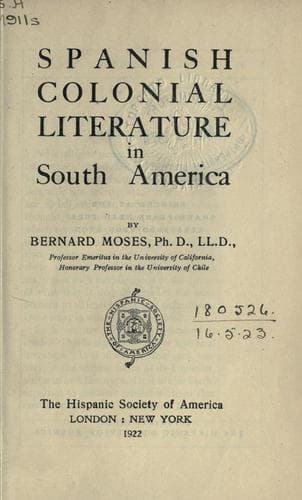
Spanish colonial literature in South AmericaMoses, Bernard
History
Spanish colonial literature in South America
Moses, Bernard
Spanish American literature -- History and criticism
[Sidenote: Parish priest at Tunja]
[Sidenote: Castellano’s _Historia_]
Castellanos was born in the little town of Alanis in the province of
Seville March 9, 1523. His father was Cristóbal Sánchez Castellanos. He
left Spain as a soldier, began his military career in Porto Rico, and
was later at Paria and in the islands of Trinidad and Cubagua. He was
transferred to the island of Margarita after the earthquake which caused
all of the colonists of Cubagua to remove to Margarita. In 1550 he was
living at Cabo de la Vela, and a little later he is known to have been at
Santa Marta, where he remained until 1552. He was at Cartagena when that
town was taken by pirates in 1559. While there, after his long experience
as a soldier, he became a priest, at thirty-nine or forty years of age,
and was appointed to be the treasurer of the cathedral, but he refused
to accept this office, and removed from the diocese. Finally, in 1561,
he was established at Tunja as the parish priest. This position he held
for forty-five years, and during this period at least a part of his means
of support was drawn from well-stocked grazing lands. At Tunja he wrote
his _Elegías de varones ilustres de las Indias_, his swan-song, as he
described it at the beginning of his first canto:
A cantos elegíacos levanto
Con débiles acentos voz anciana,
Bien como blanco cisne que con canto
Su muerte solemniza ya cercana.
The time of his death is not known, but he was living in 1588, since in
his writings he refers to events which occurred in that year, and his
holographic will bears the date of 1606, when the author was eighty-four
years old.[85]
[Sidenote: _Compendio historial de Granada_]
The manuscript of the _Historia del nuevo reino de Granada_ by
Castellanos, published for the first time by Antonio Paz y Melia in
Madrid in 1886, was held by the monastery of Poblet for a considerable
part of the seventeenth century. Piedrahita used it as well as Quesada’s
_Compendio historial de las conquistas del nuevo reino de Granada_;[86]
in fact, some part of Piedrahita’s work appears as the verse of
Castellanos reduced to prose. Castellanos’ effective literary activity
covers the twenty-two years between 1570 and 1592. During this period at
the end of which he was seventy years old, he composed the four parts
of his chronicle, containing more than 150,000 lines, and another poem
on the life, death, and miracles of San Diego de Alcalá now apparently
lost. Although Castellanos announced, in the preface of his _Historia_,
his intention to write a fifth part, this design appears not to have been
carried out.
[Sidenote: _Elegías de varones ilustres de India_]
[Sidenote: On Castellanos’ verses]
Public-domain text, read in full here on John Shaqi.
Reviews
Reviews
No reviews yet
Be the first to share your thoughts on this work.
Elsewhere in the archive
Join the Discussion
Join the discussion
Sign in to leave a comment or review.
Sign InorCreate an account