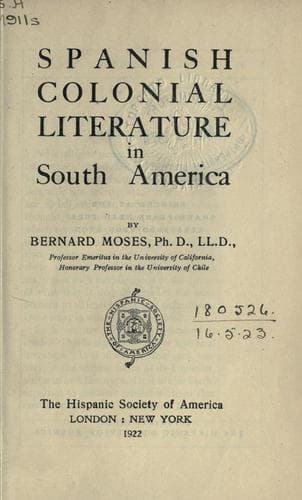
Spanish colonial literature in South AmericaMoses, Bernard
History
Spanish colonial literature in South America
Moses, Bernard
Spanish American literature -- History and criticism
A little later Centenera obtained permission to go to Peru for two
years. After his arrival at Chuquisaca the audiencia appointed him its
chaplain. He held this post, however, for only a few months, and the
next year he appeared occupying the position of vicar at Porco. In
August, 1581, Archbishop Toribio de Mogrovejo called his suffragan
bishops to a council to be held in Lima, and appointed Centenera one of
the secretaries. The clergy of Cuzco had brought charges against their
bishop, Sebastián de Lartain, who wished to have the case considered by
the council, but the archbishop decided to send it to Rome. Centenera
took the side of Lartain, and by this act incurred the displeasure of
Mogrovejo, with the consequent loss of his means of support. While under
this embarrassment the Bishop of Charcas appointed him his vicar, and the
Inquisition constituted him its commissary for the district of Cochabamba.
[Sidenote: Bishop of Paraguay arrested]
While in possession of this office Juan Ruiz del Prado, the inspector of
the Inquisition, appointed by Philip II, arrived at Lima, and in August,
1590, Centenera, in consequence of Prado’s investigation, was removed
from office and subjected to a fine of two hundred pesos. In this year
Alonso Guerra, who had arrived in Asunción as Bishop of Paraguay in
1585, was arrested and despatched to Buenos Aires as a prisoner. The
bishop’s offence appears to have been a too rigorous pursuit of funds for
the Church and threatening to excommunicate the inhabitants of Asunción
for delay in paying the tithes. From Buenos Aires Bishop Guerra went to
Charcas, where the audiencia rehabilitated him. Later the king appointed
him Bishop of Michoacán, where he died in 1594.
[Sidenote: Centenera governor of bishopric]
The sentence removing Centenera from his position as commissary of the
Inquisition made his further residence in Peru undesirable, and thus,
after an absence of nine years he returned to Asunción, where he arrived
shortly after the popular uprising against Bishop Guerra. As the bishop
had been expelled and the dean was dead, Archdeacon Centenera found
himself the highest ecclesiastical dignitary in the province, and he
became governor of the bishopric, the see being vacant. The date of his
departure from Paraguay has not become known and investigation has as yet
thrown little light on the last years of his life. Ricardo Palma accepts
as a fact that he died in Portugal in 1605, having returned to Europe
after twenty-four years spent in America.
[Illustration: Andrés Hurtado de Mendoza, 3rd Viceroy of Peru 1556-1561]
[Sidenote: Attainments of Centenera]
Public-domain text, read in full here on John Shaqi.
Reviews
Reviews
No reviews yet
Be the first to share your thoughts on this work.
Elsewhere in the archive
Join the Discussion
Join the discussion
Sign in to leave a comment or review.
Sign InorCreate an account