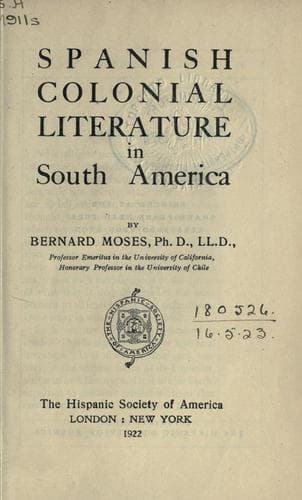
Spanish colonial literature in South AmericaMoses, Bernard
History
Spanish colonial literature in South America
Moses, Bernard
Spanish American literature -- History and criticism
Not much is known concerning the literary attainments of Centenera. As
a priest he must have known the Latin of the Breviary, but there seems
to be no evidence of an extensive knowledge of that language, “since in
all of his poem there is no indication of the least influence of the
classical Latin poets, either in the conception, in the figures, or in
the expressions. Even the locution of the poem, wanting in nobility and
elegance, proves that the author was not familiar either with the good
society or the good poets of his nation, although in one of the passages
of his poem he manifests (Canto XXIV) the highest respect for the author
of _La Araucana_.”[89] He had, however, a certain knowledge of Tasso and
Petrarch.[90]
[Sidenote: The editions of _La Argentina_]
In the archives of the Indies there is a letter, without signature or
date, ascribed by Trelles to Centenera, in which the writer, addressing
the king, says, “I have a complete history which, with the favour of
your Majesty, will be published; in it there is given an account of
Río de la Plata and of Peru.” This reference is set down as the first
mention of _La Argentina_. The writer affirms that this letter was
written fifteen years after he left Spain; if, therefore, Centenera was
the author of the letter it was written in 1587. Fifteen years later the
first edition of _La Argentina_ appeared in Lisbon (1602). The second
edition was published in 1749 by González de Barcia in his _Historiadores
primitivos_, Vol. III; the third is contained in Angelis’ _Colección de
obras y documentos, etc._, Madrid, 1836; a fourth appeared in the third
volume of the reprint of Díaz de Guzmán’s _Historia argentina_, Buenos
Aires, 1854; the fifth is in the reprint of 1900 of Angelis’ _Colección_.
In 1912 two separate facsimile reprints of the Lisbon Edition of 1602
were published in Buenos Aires, one in the _Biblioteca de la Junta de
Historia y Numismática Americana_, the other in the series _Fuentes de la
historia argentina_; the former has bio-bibliographical notes by Enrique
Peña and a critical study of the poem by J. M. Gutiérrez, the latter
notes by Carlos Navarro y Lamarca.
[Sidenote: Centenera’s spirit]
Centenera presented no great characters, like those immortalized by
Ercilla. But Ercilla was not an ecclesiastic. Centenera had entered the
New World to contribute whatever power he possessed to the destruction
of paganism, and any especially strong characters presenting themselves
among the Indians naturally appeared to him as exaggerated manifestations
of the evil he was commissioned to combat. His mission was to transform
pagan heroic qualities into Christian virtues, and not to make them live
in the admiration of later generations. What appealed to Ercilla, the
knight, as noble and worthy of honour, appeared to the archdeacon as
something to be eliminated and forgotten.
[Sidenote: Story of the voyage]
Public-domain text, read in full here on John Shaqi.
Reviews
Reviews
No reviews yet
Be the first to share your thoughts on this work.
Elsewhere in the archive
Join the Discussion
Join the discussion
Sign in to leave a comment or review.
Sign InorCreate an account