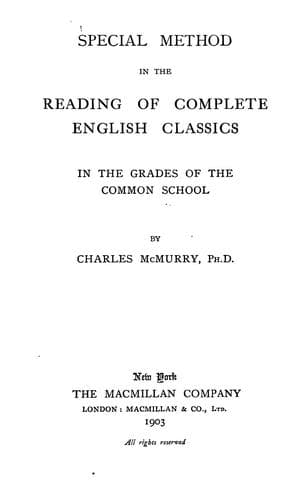
Special Method in the Reading of Complete English Classics: In the Grades of the Common SchoolMcMurry, Charles A. (Charles Alexander)
General
Special Method in the Reading of Complete English Classics: In the Grades of the Common School
McMurry, Charles A. (Charles Alexander)
American literature -- Study and teaching; English literature -- Study and teaching
Literature, both in prose and verse, is what the teacher needs, because
our best authors are our best teachers in their method of handling their
subjects. They know how to find access to the reader's mind by making
their ideas attractive, interesting, and beautiful. They seem to know
how to sharpen the edge of truth to render it more keen and incisive.
They drive truth deeper, so that it remains embedded in the life and
thought. Let a poet clothe an idea with strength and wing it with fancy,
and it will find its way straight to the heart. First of all, nearly
all our classic writers, especially those we use in the grades, handle
their subjects from the concrete, graphic, picturesque side. They not
only illustrate abundantly from nature and real things in life; they
nearly always individualize and personify their ideas. Virtue to a poet
is nothing unless it is impersonated. A true poet is never abstract or
dry or formal in his treatment of a subject. It is natural for a
literary artist, whether in verse or prose, to create pictures, to put
all his ideas into life forms and bring them close to the real ones in
nature. Homer's idea of wisdom is Minerva, war is Mars, strength is
Ajax, skill and prudence are Ulysses, faithfulness is Penelope. Dickens
does not talk about schoolmasters in general, but of Squeers.
Shakespeare's idea of jealousy is not a definition, not a formula, but
Othello. Those books which have enthralled the world, like "Robinson
Crusoe," "Pilgrim's Progress," "Gulliver's Travels," "Arabian Nights,"
"Evangeline," "Ivanhoe," "Merchant of Venice,"--they deal with no form
of classified or generalized knowledge; they give us no definitions,
they are scenes from real life. They stand among realities, and their
roots are down in the soil of things. They are persons hemmed in by the
close environment of facts.
This realism, this objectifying of thought, this living form of
knowledge, is characteristic of all great writers in prose or verse.
The novelist, the romancer, the poet, the orator, and even the essayist,
will always put the breath of reality into his work by an infusion of
concreteness, of graphic personification. The poet's fancy, building out
of the abundant materials of sense-experience, is what gives color and
warmth to all his thoughts. Strong writers make incessant use of figures
of speech. Their thought must clothe itself with the whole panoply of
imagery and graphic representation in order to be efficient in the
warfare for truth.
Public-domain text, read in full here on John Shaqi.
Reviews
Reviews
No reviews yet
Be the first to share your thoughts on this work.
Elsewhere in the archive
Join the Discussion
Join the discussion
Sign in to leave a comment or review.
Sign InorCreate an account