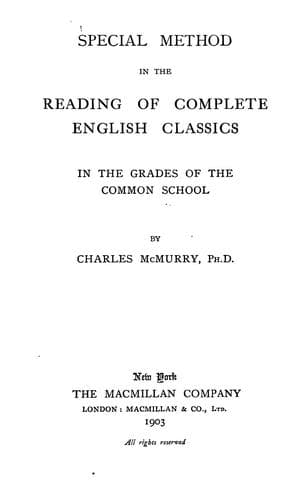
Special Method in the Reading of Complete English Classics: In the Grades of the Common SchoolMcMurry, Charles A. (Charles Alexander)
General
Special Method in the Reading of Complete English Classics: In the Grades of the Common School
McMurry, Charles A. (Charles Alexander)
American literature -- Study and teaching; English literature -- Study and teaching
Literature, in the sense in which we have been using it, has been called
the literature of power, the literature of the spirit. That is, it has
generative, spiritual life. It is not simple knowledge, it is knowledge
energized, charged with potency. It is knowledge into which the poet has
breathed the breath of life. The difference between bare knowledge and
the literature of power is like the difference between a perfect statue
in stone and a living, pulsing, human form.
One of the virtues of literature, therefore, is the mental stimulus, the
joy, the awakening, the intensity of thought it spontaneously calls
forth. Textbooks are usually a bore, but literature is a natural
resource even in hours of weariness. Who would dream of enlivening
leisure hours or vacation rest with text-books of grammar, or
arithmetic, or history, or science? But the poet soothes with music,
solemn or gay, according to our choice. If we go to the woods or lakes
to escape our friends, we take one of the masters of song with us. After
a day of toil and weariness, we can turn to "Evangeline," or "Lady of
the Lake," or the "Vision of Sir Launfal," and soon we are listening
to--
"The murmuring pines and the hemlocks,"
or the echo of the hunter's horn,--
"The deep-mouthed bloodhound's heavy bay
Resounded up the rocky way,
And faint, from farther distance borne,
Were heard the clanging hoof and horn."
At a time when we are not fit for the irksome and perfunctory
preparation of text-book lessons, we are still capable of receiving
abundant entertainment or hearty inspiration from Warner's "How I killed
a Bear," or Tennyson's "Enoch Arden," or "Sleepy Hollow." Literature is
recreation in its double sense. It gives rest and relief, and it builds
up.
Teachers should shake themselves free from the conviction that severe
disciplinary studies are the best part of education. They have their
well-merited place. But there are higher spiritual fountains from which
to draw. Read the lives of Scott, Macaulay, Irving, Hawthorne, and
Emerson, and discover that the things we do with the greatest inward
spontaneity and pleasure and ease are often the best.
Public-domain text, read in full here on John Shaqi.
Reviews
Reviews
No reviews yet
Be the first to share your thoughts on this work.
Elsewhere in the archive
Join the Discussion
Join the discussion
Sign in to leave a comment or review.
Sign InorCreate an account