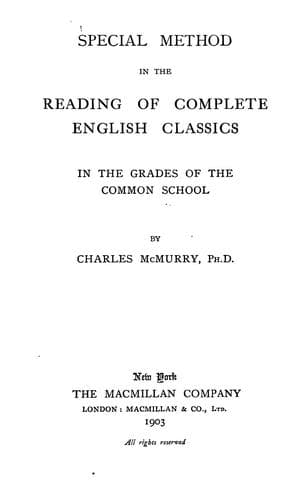
Special Method in the Reading of Complete English Classics: In the Grades of the Common SchoolMcMurry, Charles A. (Charles Alexander)
General
Special Method in the Reading of Complete English Classics: In the Grades of the Common School
McMurry, Charles A. (Charles Alexander)
American literature -- Study and teaching; English literature -- Study and teaching
We may dwell for a moment upon those qualities of Homer's story which
have commanded the admiration of the great poets in different ages and
countries. The peculiar poetic charm and power of the original Greek are
probably untranslatable, although several eminent poets have attempted
it. But we have at least both prose and verse renderings of it that are
beautiful and poetic.
Some of the critics have said that the whole poem is a perfect unit in
thought,--much more so than the "Iliad,"--centring in the person of
Ulysses. His wanderings and his final return constitute the thread of
the narrative. In the main it is a story of peace, with descriptions of
cities, islands, palaces, strange lands, and peaceful arts and manners.
After their return from Troy we meet Nestor and Menelaus, dwelling
happily in their palaces and surrounded with home comforts. Ulysses,
himself, the great sufferer, is tossed about the world, or held captive
on sea-girt, far-away islands. He passes through a series of wonderful
adventures, keeping his alertness and balance of mind so completely that
his name has become a synonym in all lands for shrewdness and far-seeing
wisdom. And it is not only a wise perception, but a self-control in the
midst of old and new temptations which is most remarkable. This
over-mastering shrewdness or calculation even overdoes itself and
becomes amusing, when he tries, for example, to deceive his guardian
goddess as to who he is. The descriptions of women and of domestic life
are famous and delightful. The constancy of Penelope, her industry and
shrewdness in outwitting the suitors, have given her a supreme place
among the women of story. The descriptions of peaceful manners and
customs, of public games, of feasting and music, of palace halls and
ornament, are among the great literary pictures of the world.
The particular adventures through which Ulysses passed with Circe, with
the Sirens, with Polyphemus, with Eolus, with the lotus-eaters, and
others, are plainly suggestive of the dangers which threaten the
thoughtless minded, those who plunge headlong into danger without
forethought. Ulysses does not give way to folly or passion, is bold and
skilful in danger, and persevering to the last extreme.
In the treatment of the "Odyssey," the teacher will need a general
knowledge of Greek mythology, which can be easily derived from "Greek
Gods, Heroes, and Men" (Scott, Foresman, & Co.), and from several other
of the reference books. Some study of Greek architecture, sculpture, and
modes of life will be instructive and helpful, as given in Smith's
"History of Greece" and other histories. Pictures of Greek temples and
ruins, sculpture, and palaces will be pleasing and attractive to
children. (See Lübke's "History of Art," Vol. I, Dodd, Mead, & Co.) Some
of the children's books also contain good pictures.
Public-domain text, read in full here on John Shaqi.
Reviews
Reviews
No reviews yet
Be the first to share your thoughts on this work.
Elsewhere in the archive
Join the Discussion
Join the discussion
Sign in to leave a comment or review.
Sign InorCreate an account