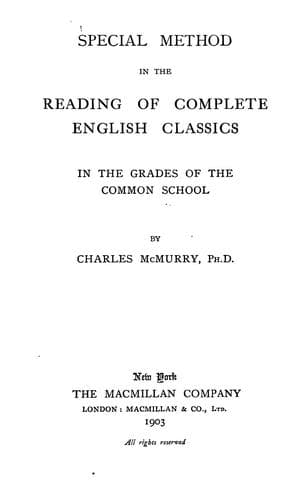
Special Method in the Reading of Complete English Classics: In the Grades of the Common SchoolMcMurry, Charles A. (Charles Alexander)
General
Special Method in the Reading of Complete English Classics: In the Grades of the Common School
McMurry, Charles A. (Charles Alexander)
American literature -- Study and teaching; English literature -- Study and teaching
It would be tedious to enter into further detail suggesting questions.
But we may believe that a spirited treatment of this part of the story
of Ulysses in reading lessons, including his stay and treatment among
the Phæacians, will give the children much appreciation of the beauty
and power of this old story. By means of occasional readings of other
selected parts of the "Odyssey," from Bryant or Palmer, some of the most
striking pictures in the story of his wanderings can be presented. Even
the children may find time for some of this additional, outside reading.
In any event the story of Ulysses, as a piece of great literature, can
thus be brought home to the understandings and hearts of children, and
will constitute henceforward a part of that rich furniture of the mind
which we call culture.
SUMMARY OF SIGNIFICANT POINTS IN READING
1. The teacher's effort is first directed to a vivid interpretation of
the author's thought and feeling, and later to an expressive rendering
of the thought.
2. Every exertion should be made to lead the children to an absorbed and
interested attention in the selections.
3. The author's leading motive in the whole selection should be firmly
grasped by the teacher. By centring all discussion toward this motive,
unnecessary digressions will be avoided.
4. The teacher will hardly teach well unless he has saturated himself
with the spirit of the selection, and enjoys it. To this end he needs
not only to study the selection, but also the historical, geographical,
biographical, and other side-lights.
5. The teacher needs great freedom and versatility in the use of his
materials. Warmth, animation, and freedom of manner are necessary.
6. Children often do not know how to study a reading lesson. In the
assignment and in the way of handling the lesson they should be taught
how to get at it, how to understand and enjoy it.
7. In the assignment of the lesson the thought of the piece should be
opened up in an interesting way, and such difficulties as children are
not likely to grapple with and master for themselves pointed out and
approached. Difficult words need to be pronounced and hard passages
explained.
8. The assignment should be unmistakably clear and definite, so as to
insure a good seat study.
9. The seat study should be chiefly on parts already discussed in class.
10. During the recitation proper, strong class attention by all the
members of the class is a first necessity. Much knowledge, alertness,
and skill are necessary to secure this. One must keep all the members of
the class in the eye constantly, and distribute the questions and work
among them promptly and judiciously, so as to secure concentrated
effort.
11. The teacher can often judge a recitation better without looking at
the book while the class is reading.
12. Skill in questioning is very useful in reading lessons.
(_a_) Questions to arouse the thought should appeal to the experience
of children.
Public-domain text, read in full here on John Shaqi.
Reviews
Reviews
No reviews yet
Be the first to share your thoughts on this work.
Elsewhere in the archive
Join the Discussion
Join the discussion
Sign in to leave a comment or review.
Sign InorCreate an account