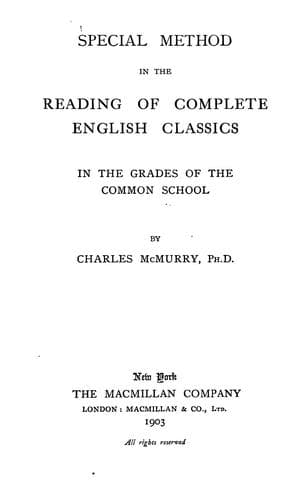
Special Method in the Reading of Complete English Classics: In the Grades of the Common SchoolMcMurry, Charles A. (Charles Alexander)
General
Special Method in the Reading of Complete English Classics: In the Grades of the Common School
McMurry, Charles A. (Charles Alexander)
American literature -- Study and teaching; English literature -- Study and teaching
(_b_) Questions to bring out the meaning of words or passages, or
to expose errors or to develop thought, should be clear and
specific, not long and ambiguous.
13. Let the teacher be satisfied with reasonable answers, and not insist
on the precise verbal form present to his own mind.
14. The teacher needs to awaken strongly the imagination in picturing
scenes, in interpreting poetic images and figures, and in impersonating
characters. The picture-forming power is stimulated by apt questions, by
suggestion of the teacher, by interpretation, by appeal to experience,
by dramatic action.
15. The use of the dialogue and dramatic representation is among the
best means of awakening interest and producing freedom and
self-forgetfulness.
16. The pupil should give his own interpretation, subject to correction,
and interpret parts in relation to the whole.
17. Without too much loss of time children should learn to help
themselves in overcoming difficulties in solving problems.
18. Sometimes it is well for children to come prepared to ask definite
questions on parts they do not understand.
19. The tendency to more independent and mature thinking is encouraged
by comparing similar ideas, figures of speech, and language in different
poems and from different authors.
20. There should be much effective reading and not much mere oral
reproduction. The paraphrase may be used at times to give the pupil a
larger view of the content of the piece.
21. Let the pupil reading feel responsible for giving to the class the
content of the printed page. Often it is best to face the class.
22. The teacher should occasionally read a passage in the best style for
the pupils, not for direct imitation, but to suggest the higher ideals
and spirit of good reading. A high standard is thus set up.
23. Children should be encouraged to learn by heart the passages they
like. In the midst of the recitation it is well occasionally to memorize
a passage.
24. The teacher must drill himself in clear-cut enunciation of short
vowels, final consonants, and pure vowel sounds. Cultivate also a quick
ear for accurate enunciation in the pupils and for pleasing tones.
Frequent drill exercise, singly and in concert, is necessary.
25. Use ingenuity by indirect methods to overcome nasality, stuttering,
nervously rapid reading, slovenly and careless expression, monotone, and
singsong.
26. By means of physical training, deep breathing, vigorous thought
work, encourage to self-reliant manner and good physical position.
27. Give variety to each lesson; avoid monotony and humdrum.
28. Each lesson should emphasize a particular aim, determined by the
nature of the selection or by the previous bad habits and faults of the
children in reading. It is impossible to give proper emphasis to all
things in each lesson, and indefiniteness and monotony are the result.
CHAPTER VI
THE VALUE OF CLASSICS TO THE TEACHER
Public-domain text, read in full here on John Shaqi.
Reviews
Reviews
No reviews yet
Be the first to share your thoughts on this work.
Elsewhere in the archive
Join the Discussion
Join the discussion
Sign in to leave a comment or review.
Sign InorCreate an account