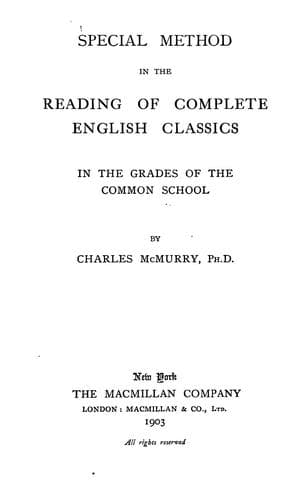
Special Method in the Reading of Complete English Classics: In the Grades of the Common SchoolMcMurry, Charles A. (Charles Alexander)
General
Special Method in the Reading of Complete English Classics: In the Grades of the Common School
McMurry, Charles A. (Charles Alexander)
American literature -- Study and teaching; English literature -- Study and teaching
"In the second place, literature provides us with historical landmarks.
We cannot be said to understand the general 'history' of a particular
time unless we know something of the thought that stirred its most
subtle thinkers, and interpreted and made articulate the spirit of the
times in which they lived. The most notable facts in the history of the
times of Edward III, of Elizabeth, and of Victoria are that Chaucer and
Shakespeare and Tennyson and their contemporaries lived and wrote.
Political history, social history, economic history, even ecclesiastical
history, are all reflected, illustrated, and interpreted by what we find
in the great works of contemporary literature."
Charles Kingsley, in his "Literary and General Essays" (p. 249), holds a
like opinion:--
"I said that the ages of history were analogous to the ages of man, and
that each age of literature was the truest picture of the history of its
day, and for this very reason English literature is the best, perhaps
the only, teacher of English history, to women especially. For it seems
to me that it is principally by the help of such an extended literary
course that we can cultivate a just and enlarged taste which will
connect education with the deepest feelings of the heart."
Literature is also a mirror that reflects many sides of social life and
usage. There is no part of a teacher's education that is so vital to his
practical success as social culture. John Locke's "Thoughts on
Education" are, in the main, an inquiry into the methods and means by
which an English gentleman can be formed. The aim of the tutor who has
this difficult task is not chiefly to give learning, to fill the mind
with information, to develop mentality, but to train the practical
judgment in harmony with gentlemanly conduct. The tutor, himself a
scholar, is to know the world, its ins and outs, its varieties of social
distinction and usage, its snares and pitfalls, its wise men and fools.
The child is to learn to look the world in the face and understand it,
to know himself and to be master of himself and of his conduct, to
appreciate other people in their moods and characters, and to adapt
himself prudently and with tact to the practical needs. The gentleman
whom Locke sets up as his ideal is not a fashion-plate figure, not a
drawing-room gallant, but a clear-headed man who understands other
people and himself, and has been led by insensible degrees to so shape
his habitual conduct as most wisely to answer his needs in the real
world. Emerson, with all his lofty idealism and unconventionalism, has
an ideal of education nearly akin to that of Locke. This social ideal
of Locke and Emerson is one that American teachers can well afford to
ponder. As a nation, we have been accustomed to think that a certain
amount of roughness and boorishness was necessary as a veil to cover the
strongest manly qualities. Smoothness and tact and polish, however
Public-domain text, read in full here on John Shaqi.
Reviews
Reviews
No reviews yet
Be the first to share your thoughts on this work.
Elsewhere in the archive
Join the Discussion
Join the discussion
Sign in to leave a comment or review.
Sign InorCreate an account