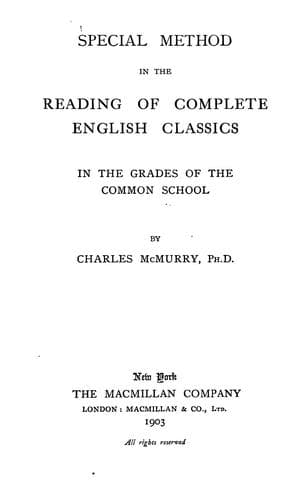
Special Method in the Reading of Complete English Classics: In the Grades of the Common SchoolMcMurry, Charles A. (Charles Alexander)
General
Special Method in the Reading of Complete English Classics: In the Grades of the Common School
McMurry, Charles A. (Charles Alexander)
American literature -- Study and teaching; English literature -- Study and teaching
successful they may be in real life, are, theoretically at least, at a
discount. The Adamses, Jefferson, Jackson, Lincoln, Thoreau, were men
who did violence in a good many ways to social usages, and we may admire
their faults overmuch.
To the teacher who stands in the presence of thirty or fifty distinct
species of incipient men and women, social insight and culture, the
ability to appreciate each in his individual traits, his strength or
weakness, are a prime essential to good educative work.
Now, there are two avenues through which social culture is
attainable,--contact with men and women in the social environment which
envelops us all, and literature. Literature is, first of all, a
hundred-sided revelation of human conduct as springing from motive.
Irving, Hawthorne, Longfellow, Holmes, and Lowell are revealers of
humanity. Still more so are Dickens and Eliot and Shakespeare and
Goethe. To study these authors is not simply to enjoy the graphic power
of an artist, but to look into the lives of so many varieties of men and
women. They lay bare the heart and its inward promptings. Our
appreciation for many forms of life under widely differing conditions
is awakened. We come in touch with those typical varieties of men and
women whom we shall daily meet if we will but notice. It broadens one's
perceptions and sympathies, it reveals the many-sidedness of human life.
It suggests to a teacher that the forty varieties of humanity in her
schoolroom are not after one pattern, nor to be manipulated according to
a single device.
The social life that surrounds each one of us is small and limited. Our
intimate companionships are few, and we can see deeply into the inner
life of but a small portion even of those about us. The deeper life of
thought and feeling is largely covered up with conventionalities and
externalities. But in the works of the best novelists, dramatists, and
poets, we may look abroad into the whole world of time and place, upon
an infinite variety of social conditions, and we are permitted to see
directly into the inner thought and motive, the very soul of the actors.
Yet fidelity to human nature and real life is claimed to be the peculiar
merit of these great writers. By the common consent of critics,
Shakespeare is the prince of character delineators. Schlegel says of
him:--
"Shakespeare's knowledge of mankind has become proverbial; in this his
superiority is so great that he has justly been called the master of the
human heart. A readiness to remark the mind's fainter and involuntary
utterances, and the power to express with certainty the meaning of these
signs, as determined by experience and reflection, constitute 'the
observer of men.'"
Public-domain text, read in full here on John Shaqi.
Reviews
Reviews
No reviews yet
Be the first to share your thoughts on this work.
Elsewhere in the archive
Join the Discussion
Join the discussion
Sign in to leave a comment or review.
Sign InorCreate an account