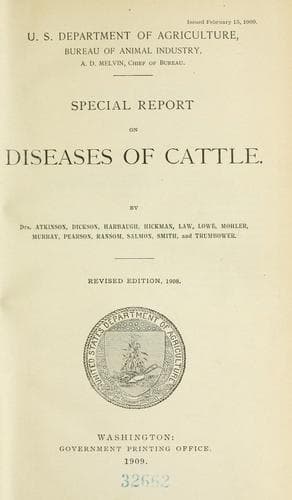
Special report on diseases of cattleUnited States. Bureau of Animal Industry
Science
Special report on diseases of cattle
United States. Bureau of Animal Industry
Cattle -- Diseases
_Polydesmus exitans_ grows on the leaves of rape and turnips, appearing in
early summer. This fungus is very irritating to the mouths and feet of
cattle, causing severe inflammation and the formation of a false membrane.
In some instances this condition has been mistaken for foot-and-mouth
disease, but it can be differentiated by the absence of the blister that
is characteristic of that disease and by the further fact that it is
nontransmissible.
_Polytrincium trifolii_, which grows on clover, causing it to become black,
causes severe irritation of the stomach and intestines of cattle feeding
upon it.
Feeds must not contain too large a proportion of woody fiber or of
indigestible substances. If the dry matter ingested or the bulk of the feed
is very great on account of the small proportion of digestible matter, it
is impossible for the great mass to be moistened properly with and attacked
by the digestive juices. In consequence of this, abnormal fermentations
arise, causing indigestion and irritation of the digestive organs. On the
other hand, a ration too concentrated, and especially too rich in protein,
is not suitable, because, after a meal, the animal must have a certain
feeling of fullness in order to be comfortable and quiet, and the digestive
organs require a relatively large volume of contents to fill them to the
point where secretion is properly stimulated and their activity is most
efficient. If too much protein is in the ration there is a waste of
expensive feed, and the tendency is for the animal to become thin. It is
evident that a cow can not thrive on concentrated feeds alone, even though
these contain in assimilable form all the nutritive materials needed for
perfect support. It is because bulk is necessary that the standard of about
25 pounds of dry matter per cow per day has been reached by experimenters.
There is no objection to feeding grain or meal separately to a cow,
provided enough bulky feed is fed at another time in the day to keep the
digestive tract sufficiently distended.
In changing the ration, and especially in making radical changes, as at the
beginning and the end of the pasturing season, the change should be made
gradually, so that the digestive organs may accommodate themselves to it.
After the digestive organs and juices have from long practice become
adjusted to the digestion of a certain feed, which is then suddenly
withheld and another of quite different character and properties is
substituted, the second feed is not well digested; it may even irritate the
digestive canal. It is often observed that cattle lose from 25 to 100
pounds when turned on pasture from dry stable feed. This loss can readily
be prevented by not shocking the digestive organs by a sudden change of
diet.
Regularity in feeding has much to do with the utilization of the ration,
and gross irregularity may cause indigestion and serious disease.
Public-domain text, read in full here on John Shaqi.
Reviews
Reviews
No reviews yet
Be the first to share your thoughts on this work.
Join the Discussion
Join the discussion
Sign in to leave a comment or review.
Sign InorCreate an account