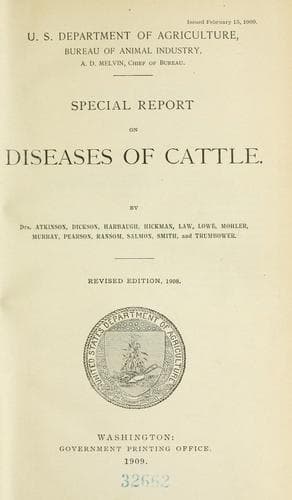
Special report on diseases of cattleUnited States. Bureau of Animal Industry
Science
Special report on diseases of cattle
United States. Bureau of Animal Industry
Cattle -- Diseases
_Treatment._--So long as the beating of the heart is perceptible the
endeavor to resuscitate the animal should be continued. Dash cold water
over the head and body; rub the body and legs; smartly whip the body with
wet towels or switches. Mustard, mixed with water, should be well rubbed
over the legs and back of the head on each side of the neck. Inject into
the rectum 4 drams of stronger liquor ammonia, or 1-1/2 ounces of hartshorn
diluted with a quart of warm water. Cautiously hold an uncorked bottle of
hartshorn to the nostrils, so that some of it is inhaled, but care should
be taken that too much is not suddenly inhaled. If the animal is
unconscious, hypodermic injections of stimulants are indicated, such as 6
drams of camphorated oil in one dose, subcutaneously, or 20 grains of
caffein or 1/2 grain of strychnin, also subcutaneously.
When the animal revives sufficiently to be able to swallow, 4 drams of the
stronger liquor ammonia, diluted with a quart of cold water, should be
given as a drench, and the dose should be repeated in an hour. One and
one-half ounces of ordinary hartshorn may be used instead of the stronger
liquor ammonia, but, like the latter, it should be diluted with a quart or
more of water, and even then care should be exercised in drenching.
In cases where the shock has not caused complete insensibility recovery may
be hastened by the ammonia and water drench, or 4 ounces of brandy diluted
with a quart of water, or 8 ounces of whisky diluted with a quart of water.
These doses may be given every three or four hours if necessary. After
recovery from the more serious symptoms 2 drams of sulphate of quinin
should be given twice a day until health is restored. If any paralysis
remains 1-1/2 drams of pulverized nux vomica should be given twice a day
with the quinin.
The foregoing treatment is also applicable when the electrical shock is
given by telephone, electric car, or electric-light wires, etc. The wounds,
burns, or blisters should be treated according to the antiseptic method of
treating wounds.
TUMORS IN THE BRAIN, ETC.
Tumors of different kinds have been found within the cranial cavity, and in
many cases there have been no well-marked symptoms exhibited during the
life of the animal to lead one to suspect their existence. Cases are
recorded where bony tumors have been found in the brain of cattle that died
suddenly, but during life no signs of disease were manifested. Post-mortem
examinations have disclosed tubercles in the membranes of the brain. (See
"Tuberculosis," p. 407.) Abscesses, usually the result of inflammation of
the brain, have been found post-mortem. For the description of
hydrocephalus, or dropsy of the brain, of calves the reader is referred to
the section on parturition. (See "Water in the head," p. 179.)
Chorea, constant twitching and irregular spasmodic movements of the
muscles, has been noticed in connection with or as a sequel to other
affections, as, for example, parturient apoplexy.
Public-domain text, read in full here on John Shaqi.
Reviews
Reviews
No reviews yet
Be the first to share your thoughts on this work.
Elsewhere in the archive
Join the Discussion
Join the discussion
Sign in to leave a comment or review.
Sign InorCreate an account