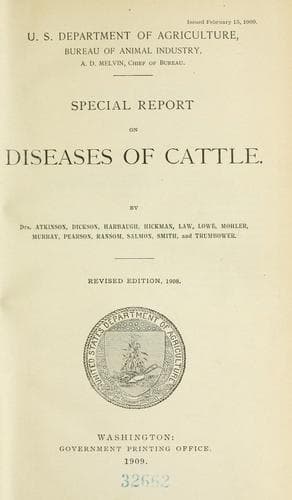
Special report on diseases of cattleUnited States. Bureau of Animal Industry
Science
Special report on diseases of cattle
United States. Bureau of Animal Industry
Cattle -- Diseases
Various diseases, the description of which will be found in other sections
of this work, affect the nervous system to a greater or less extent--for
example, ergotism, lead poisoning, uremia, parturient apoplexy, colic, and
other affections associated with cramps, or spasms, etc. Disease of the
ovaries or of the spinal cord, by reflex irritation, may cause estromania
(see "Excess of venereal desire," p. 148, constant desire for the bull).
DISEASES OF THE URINARY ORGANS.
By JAMES LAW, F. R. C. V. S.,
_Formerly Professor of Veterinary Science, etc., in Cornell University._
Of the materials that have served their purpose in building up the animal
body or in sustaining the body temperature, and that are now to be thrown
out as waste, the greater part is expelled from the system through the
lungs and the kidneys, but the agents that pass out by either of these two
channels differ in the main from those passing by the other. Thus from the
lungs in the form of dioxid of carbon--the same gas that comes from burning
of coal or oil--there escapes most of the waste material resulting from the
destruction in the system of fats, sugars, starch, and such other foods as
are wanting in the element nitrogen, and do not form fibrous tissues, but
go mainly to support animal heat or maintain functional activity. From the
kidneys, on the other hand, are thrown out the waste products resulting
from the destruction of the foods and tissues containing nitrogen--of, for
instance, albumin, fibrin, gluten, casein, gelatin, woody tissue, etc.
While much of the waste material containing nitrogen leaves the body by the
bowels, this is virtually only such of the albuminoid food as has failed to
be fully digested and absorbed; this has never formed a true constituent
part of the body itself or of the blood, but is so much waste food, like
that which has come to the table and again carried away unused. If the
albuminoid food element has entered the blood, whether or not it has been
built up into a constituent part of the structure of the body, its waste
products, which contain nitrogen, are in the main expelled through the
kidneys, so that the latter become the principal channels for the expulsion
of all nitrogen-containing waste.
Public-domain text, read in full here on John Shaqi.
Reviews
Reviews
No reviews yet
Be the first to share your thoughts on this work.
Elsewhere in the archive
Join the Discussion
Join the discussion
Sign in to leave a comment or review.
Sign InorCreate an account