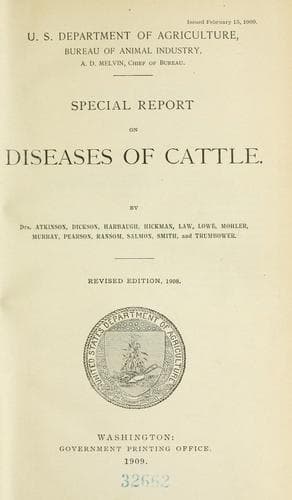
Special report on diseases of cattleUnited States. Bureau of Animal Industry
Science
Special report on diseases of cattle
United States. Bureau of Animal Industry
Cattle -- Diseases
Another insoluble salt which enters largely into the composition of many
urinary calculi of the ox is carbonate of lime. This is derived mainly from
the lime in the feed and water and from the carbon dioxid formed by the
oxidation of the organic acids in the fodder. These organic acids, being
composed of carbon, hydrogen, and oxygen (without nitrogen), are resolved
by the addition of oxygen into carbon dioxid (CO_{2}) and water (H_{2}O).
The carbon dioxid unites with the lime in the blood to form carbonate of
lime, and in this state passes into the urine. Now, carbonate of lime is
soluble in water containing free or uncombined carbon dioxid, but is
precipitated whenever the latter is withdrawn. It is only necessary,
therefore, to have in the urine sufficient lime or other available base to
unite with all the free carbon dioxid in order to bring about the
precipitation of the dissolved carbonate of lime in the solid, crystallized
form; hence it is that, of all sediments in the urine of herbivora, this is
the most frequent and usually the most abundant.
A less common constituent of urinary calculi is the insoluble oxalate of
lime. In this case the lime is derived as before from the feed or water, or
both, while the oxalic acid is a product of the oxidation of organic acids
of the feed, less oxygen having been used than in the formation of carbon
dioxid. The final product of the complete oxidation of these acids is
carbon dioxid, but when less oxygen is furnished, owing to some disease of
the lungs or a disease of the nerve centers, which lessens the activity of
the breathing, then oxalic acid may be produced. If this oxalic acid comes
into contact with lime, it is instantly precipitated as crystals of oxalate
of lime.
Another inorganic substance at times found in urinary calculi is silica
(SiO_{2}). This contributes largely to giving stiffness to the stems of
growing plants, and in most of our cereals and grasses makes up a large
proportion of the ashes of the burned plant. It is found in the soluble
form in combination as silicate of potash, but at times is displaced by
oxalic or other acid and then appears as gritty, sandy particles in the
stem. This gritty, insoluble silica is especially noticeable among the
horsetails (_EquisetacÊceÊ_), bamboos, and sedges. The per cent of silica
in the ash of several common fodder plants is given below:
_Silica in ash of various fodder plants._
Ash of-- Silica.
_Per cent._
Wheat straw 67.6
Oats and husk 38.6
Oat straw 35.4
Barley straw 73.1
Rye straw 64.4
Rye-grass hay 64.57
Wheat chaff 81.2
Oat chaff 59.9
Barley awn 70.7
Public-domain text, read in full here on John Shaqi.
Reviews
Reviews
No reviews yet
Be the first to share your thoughts on this work.
Elsewhere in the archive
Join the Discussion
Join the discussion
Sign in to leave a comment or review.
Sign InorCreate an account