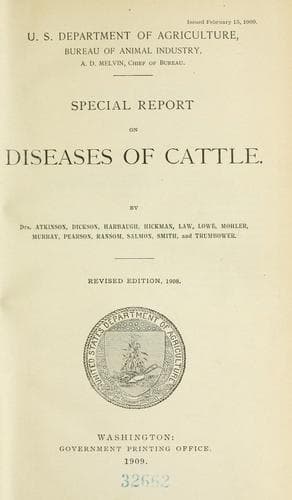
Special report on diseases of cattleUnited States. Bureau of Animal Industry
Science
Special report on diseases of cattle
United States. Bureau of Animal Industry
Cattle -- Diseases
It is only soluble silica that is taken up into the system, and it is in
this form (usually as silicate of potash or soda) that it enters the urine,
but all that is wanted to precipitate it in crystalline form as a gritty
sand is the presence of oxalic or other acid having a stronger affinity for
its base (potash or soda).
Other conditions, however, enter largely into the causation of stone, or
gravel. A high density of urine resulting from a highly saturated condition
is often present for a length of time without any precipitation of solid
materials. Urea and carbonates may be present in excess, the feed may be
given dry, and drinking water may be deficient in quantity without any
deposition of stone or gravel. In such cases, the presence of
noncrystalline organic matter in the urine becomes an exciting cause.
Rainey and Ord have shown experimentally that colloid (noncrystallizable)
bodies like mucus, epithelial cells, albumin, pus, blood, hyaline casts of
the kidney tubes, etc., not only determine the precipitation of
crystallizable salts from a strong solution, but they determine the
precipitation in the form of globular masses, or minute spheres, which, by
further similar accessions, become stones, or calculi, of various sizes.
The salts that are deposited by mere chemical reaction without the
intervention of colloids appear in the form of sharply defined angular
crystals, and hence the rough, jagged crystals of oxalate of lime or
ammonia-magnesium phosphate. Heat intensifies the action of the colloids in
causing precipitation of the dissolved salts, so that the temperatures of
the kidneys and bladder constitute favorable conditions. Colloids that are
undergoing decomposition are also specially powerful, so that the presence
of bacteria or fungi causing fermentation is an important factor.
Public-domain text, read in full here on John Shaqi.
Reviews
Reviews
No reviews yet
Be the first to share your thoughts on this work.
Elsewhere in the archive
Join the Discussion
Join the discussion
Sign in to leave a comment or review.
Sign InorCreate an account