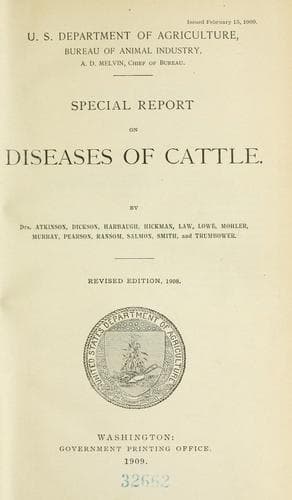
Special report on diseases of cattleUnited States. Bureau of Animal Industry
Science
Special report on diseases of cattle
United States. Bureau of Animal Industry
Cattle -- Diseases
Fig. 1. Calculus, or stone, from the kidney. These are in the pelvis or
portion of the ureter receiving the urine. The prolongations are casts of
the branches of the pelvis. See the plates of the kidney for further
description.
Fig. 2. Calculus made up of oxalate of lime magnified 215 times.
Fig. 3. Phosphatic calculus containing a nucleus of uric acid, sawed
through to show concentric layers.
Fig. 4. Straight forceps used in removing stones from the bladder.
Fig. 5. Casts of the minute tubules of the kidney found in the urine in
various kinds of kidney disease. Highly magnified.
* * * * *
[Illustration: Plate XI.
CALCULI OF KIDNEY AND BLADDER.]
FOOTNOTES:
[1] Encyklop. der Thierheilk., Vol. IV, p. 208.
DISEASES OF THE GENERATIVE ORGANS.
By JAMES LAW, F. R. C. V. S.,
_Formerly Professor of Veterinary Science, etc., in Cornell University._
[Revised by Adolph Eichhorn, D. V. S.]
GENERAL DISCUSSION.
Diseases of the generative organs are practically confined to animals which
are kept for reproduction and the dairy. The castration of the bull
condemns these organs to inactivity and protects them from the many causes
of injury attendant on the engorged blood vessels in the frequent periods
of sexual excitement, on the exposure to mechanical violence, and on the
exposure to infective inoculation. In three respects the castrated male is
especially subject to disease: (1) To inflammation and tumefaction of the
cut end of the cord that supported the testicle and of the loose connective
tissue of the scrotum; (2) to inflammation of the sheath and penis from the
accumulation of gravel in the former, from which the penis is not usually
protruded in passing water; and (3) to bruising, abrasion, and inflammation
of the sheath and penis during suspension in the stocks for the purpose of
shoeing. Apart from these the ox is practically almost exempt from the
inflammations and injuries of the genital organs. The same applies to the
castrated heifer. Inflammation may occur in the broad ligament of the womb
whence the ovary has been removed or infective inflammation in the
abdominal cavity (peritonitis) in case the operation has been performed
through the flank, as it usually is in the young heifer. Apart from these,
the castrated heifer is practically immune from any trouble of the
generative apparatus. Even the virgin heifer is little subject to such
troubles, though she is not exempt from inflammations, and above all, from
morbid growths in the ovaries which are well developed and functionally
very active after the first year, or in precocious animals after the first
few months of life. The breeding cow, on the other hand, is subjected to
all the disturbances attendant on the gradual enlargement of the womb, the
diversion of a large mass of blood to its walls, the constant drain of
nutrient materials of all kinds for the nourishment of the fetus, the risks
Public-domain text, read in full here on John Shaqi.
Reviews
Reviews
No reviews yet
Be the first to share your thoughts on this work.
Elsewhere in the archive
Join the Discussion
Join the discussion
Sign in to leave a comment or review.
Sign InorCreate an account