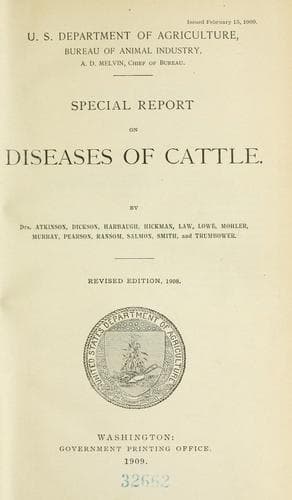
Special report on diseases of cattleUnited States. Bureau of Animal Industry
Science
Special report on diseases of cattle
United States. Bureau of Animal Industry
Cattle -- Diseases
attendant and consequent on abortion and parturition, the dangers of
infection from the bull, the risks of sympathetic disturbance in case of
serious diseases of other organs, but preeminently of the urinary organs
and the udder, and finally the sudden extreme derangements of the
circulation and of the nervous functions which attend on the sudden
revulsion of a great mass of blood from the walls of the contracting womb
into the body at large immediately after calving.
In reviewing this class of diseases, therefore, we have to note, first,
that they are almost exclusively restricted to breeding animals, and
secondly that in keeping with the absolute difference of the organs in the
male and female we find two essentially distinct lists of diseases
affecting the two sexes.
EXCESS OF VENEREAL DESIRE (SATYRIASIS IN MALE, OR NYMPHOMANIA IN FEMALE).
This may occur in the male from too frequent sexual intercourse, or from
injury and congestion of the base of the brain (vasodilator center in the
medulla), or of the posterior end of the spinal cord, or it may be kept up
by congestion or inflammation of the testicles or of the mucous membrane
covering the penis. It may be manifested by a constant or frequent
erection, by attempts at sexual connection, and sometimes by the discharge
of semen without connection. In bad cases the feverishness and restlessness
lead to loss of flesh, emaciation, and physical weakness.
It is, however, in the female especially that this morbid desire is most
noticeable and injurious. It may be excited by the stimulating quality of
the blood in cows fed to excess on highly nitrogenous feed, as the seeds of
the bean, pea, vetch, and tare, and as wheat bran, middlings, cotton seed,
gluten meal, etc., especially in the case of such as have no free exercise
in the fields, and are subject to constant association with a vigorous
young bull. A more frequent cause is the excitation or congestion of some
part of the genital organs. Disease of the ovaries is preeminently the
cause, and this may be by the formation of cysts (sacs containing liquid)
or of solid tumors or degenerations, or, more commonly than all, the
formation of tubercle. Indeed, in case of tuberculosis attacking the
abdominal organs of cows, the ovaries or the serous membranes that support
and cover them (the broad ligaments of the womb) are peculiarly subject to
attack, and the animal has constant sexual excitement, incessantly riding
or being ridden by other cattle, having no leisure to eat or chew the cud,
but moving restlessly, wearing the flesh off its bones, and gradually
wasting. In some localities these cows are known as "bullers," because they
are nearly always disposed to take the bull, but they do not conceive, or,
if they do, they are subject to early abortions. They are, therefore,
useless alike for the dairy and for the feeder, unless the removal of the
ovaries subdues the sexual excitement, when, in the absence of tuberculous
Public-domain text, read in full here on John Shaqi.
Reviews
Reviews
No reviews yet
Be the first to share your thoughts on this work.
Elsewhere in the archive
Join the Discussion
Join the discussion
Sign in to leave a comment or review.
Sign InorCreate an account