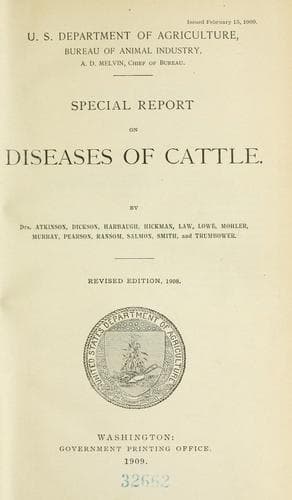
Special report on diseases of cattleUnited States. Bureau of Animal Industry
Science
Special report on diseases of cattle
United States. Bureau of Animal Industry
Cattle -- Diseases
Abortion in cows is either contagious or noncontagious. It does not follow
that the contagium is the sole cause in every case in which it is present.
We know that the organized germs (microbes) of contagion vary much in
potency at different times, and that the animal system also varies in
susceptibility to their attack. The germ may therefore be present in a herd
without any manifest injury, its disease-producing power having for the
time abated considerably, or the whole herd being in a condition of
comparative insusceptibility. At other times the same germ may have become
so virulent that almost all pregnant cows succumb to its force, or the herd
may have been subjected to other causes of abortion which, though of
themselves powerless to actually cause abortion, may yet so predispose the
animals that even the weaker germ will operate with destructive effect. In
dealing with this disease, therefore, it is the part of wisdom not to rest
satisfied with the discovery and removal of one specific cause, but rather
to try to find every existent cause and to obtain a remedy by correcting
all the harmful conditions.
NONCONTAGIOUS ABORTION.
As abortion most frequently occurs at those three-week intervals at which
the cow would have been in heat if nonpregnant, we may assume a
predisposition at such times owing to a periodicity in the nervous system
and functions. Poor condition, weakness, and a too watery state of the
blood is often a predisposing cause. This in its turn may result from poor
or insufficient feed, from the excessive drain upon the udder while bearing
the calf, from the use of feed deficient in certain essential elements,
like the nitrogenous constituents or albuminoids, from chronic, wasting
diseases, from roundworms or tapeworms in the bowels, from flat-worms
(flukes, trematodes) in the liver, from worms in the lungs, from dark,
damp, unhealthful buildings, etc. In some such cases the nourishment is so
deficient that the fetus dies in the womb and is expelled in consequence.
Excessive loss of blood, attended as it usually is with shock, becomes a
direct cause of abortion.
Acute inflammations of important organs are notorious causes of abortion,
and in most contagious fevers (lung plague, rinderpest, foot-and-mouth
disease) it is a common result. Affections of the chest which prevent due
aeration of the blood induce contractions of the womb, as shown
experimentally by Brown-Sequard. Pregnant women suffocated in smoke aborted
in many cases. (Retoul.)
Public-domain text, read in full here on John Shaqi.
Reviews
Reviews
No reviews yet
Be the first to share your thoughts on this work.
Elsewhere in the archive
Join the Discussion
Join the discussion
Sign in to leave a comment or review.
Sign InorCreate an account