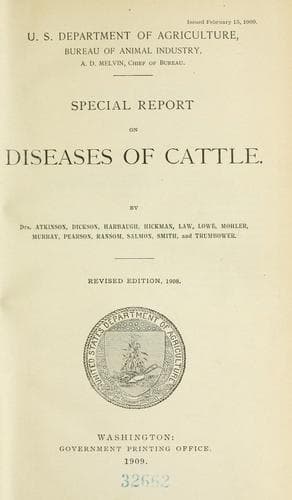
Special report on diseases of cattleUnited States. Bureau of Animal Industry
Science
Special report on diseases of cattle
United States. Bureau of Animal Industry
Cattle -- Diseases
Ergoted grasses have long been known as a cause of widespread abortion in
cows. The ergot is familiar as the dark purple or black, hard, spurlike
growths which protrude from the seeds of the grasses at the period of their
ripening. (Pl. V.) It is especially common, in damp localities and cloudy
seasons on meadows shaded by trees and protected against the free sweep of
the winds. The same is to a large extent true of smut; hence, wet years
have been often remarkable for the great prevalence of abortions. Abortions
have greatly increased in New Zealand among cows since the introduction of
rye grass, which is specially subject to ergot. As abortion is more
prevalent in old dairying districts, the ergot may not be the sole cause in
this instance.
The riding of one another by cows is attended by such severe muscular
exertion, jars, jolts, mental excitement, and gravitation of the womb and
abdominal organs backward that it may easily cause abortion in a
predisposed animal.
Keeping in stalls that slope too much behind (more than 2 inches) acts in
the same way, the compression from lying and the gravitation backward
proving more than a predisposed cow can safely bear.
Deep gutters behind the stalls, into which one or both hind limbs slip
unexpectedly, strain the loins and jar the body and womb most injuriously.
Slippery stalls in which the flooring boards are laid longitudinally in
place of transversely, and on which there is no device to give a firm
foothold, are almost equally dangerous. Driving on icy ground, or through a
narrow doorway where the abdomen is liable to be jammed, are other common
causes. Aborting cows often fail to expel the afterbirth, and if this
remains hanging in a putrid condition it is most injurious to pregnant cows
in the near vicinity. So with retained afterbirth in other cows after
calving. That some cows kept in filthy stables or with slaughterhouses near
by may become inured to the odors and escape the evil results is no
disproof of the injurious effects so often seen in such cases.
The excitement, jarring, and jolting of a railroad journey often cause
abortion, especially as the cow nears the period of calving, and the terror
or injury of railway or other accidents proves incomparably worse.
All irritant poisons cause abortions by the disorder and inflammation of
the digestive organs, and if such agents act also on the kidneys or womb,
the effect is materially enhanced. Powerful purgatives or diuretics should
never be administered to the pregnant cow.
Public-domain text, read in full here on John Shaqi.
Reviews
Reviews
No reviews yet
Be the first to share your thoughts on this work.
Elsewhere in the archive
Join the Discussion
Join the discussion
Sign in to leave a comment or review.
Sign InorCreate an account