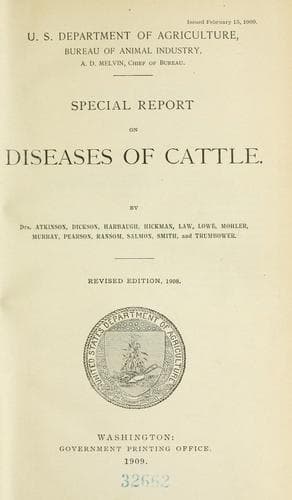
Special report on diseases of cattleUnited States. Bureau of Animal Industry
Science
Special report on diseases of cattle
United States. Bureau of Animal Industry
Cattle -- Diseases
This occurs from watery blood or disease of some internal organ, like the
liver or kidney, and is recognized by the general puffed-up and rounded
condition of the body, which pits everywhere on pressure but without
crackling. If not too extreme a case, the calf may be extracted after it
has been very generally punctured over the body, but usually the only
resort is to extract it in pieces. (See "Embryotomy," p. 202.)
SWELLING OF THE CALF WITH GAS.
This is usually the result of the death and decomposition of the fetus when
extraction has been delayed for a day or more after the escape of the
waters. It is impossible to extract it whole, owing to its large size and
the dry state of the skin of the calf, the membranes, and the wall of the
womb. These dry surfaces stick with such tenacity that no attempt at
traction leads to any advance of the calf out of the womb or into the
passages. When the fetus is advanced the adherent womb advances with it,
and when the strain is relaxed both recede to where they were at first. The
condition may be helped somewhat by the free injection of oil into the
womb, but it remains impossible to extract the enormously bloated body, and
the only resort is to cut it in pieces and extract it by degrees. (See
"Embryotomy," p. 202.)
RIGID CONTRACTIONS OF MUSCLES.
In the development of the calf, as in after life, the muscles are subject
to cramps, and in certain cases given groups of muscles remain unnaturally
short, so that even the bones grow in a twisted and distorted way. In one
case the head and neck are drawn round to one side and can not be
straightened out, even the bones of the face and the nose being curved
around to that side. In other cases the flexor muscles of the fore legs are
so shortened that the knees are kept constantly bent and can not be
extended by force. The bent neck may sometimes be sufficiently straightened
for extraction by cutting across the muscles on the side to which it is
turned, and the bent knees by cutting the cords on the back of the shank
bones just below the knees. If this fails, there remains the resort of
cutting off the distorted limbs or head. (See "Embryotomy," p. 202.)
TUMORS OF THE CALF (INCLOSED OVUM).
Public-domain text, read in full here on John Shaqi.
Reviews
Reviews
No reviews yet
Be the first to share your thoughts on this work.
Elsewhere in the archive
Join the Discussion
Join the discussion
Sign in to leave a comment or review.
Sign InorCreate an account