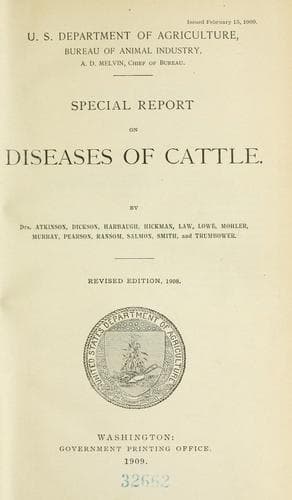
Special report on diseases of cattleUnited States. Bureau of Animal Industry
Science
Special report on diseases of cattle
United States. Bureau of Animal Industry
Cattle -- Diseases
Tumors or new growths grow on the unborn calf as on the mature animal, and
by increasing the diameter of the body render its progress through the
passage of the pelvis impossible. In my experience with large, fleshy
tumors of the abdomen, I have cut open the chest, removed the lungs and
heart, cut through the diaphragm with the knife, and removed the tumor
piecemeal by alternate tearing and cutting until the volume of the body was
sufficiently reduced to pass through. Where this failed it would remain to
cut off the anterior part of the body, removing as much of the chest as
possible, and cutting freely through the diaphragm; then, pushing back the
remainder of the body, the hind limbs may be seized and brought into the
passages and the residue thus extracted. The tumor, unless very large, will
get displaced backward so as not to prove an insuperable obstacle.
In many cases the apparent tumor is a blighted ovum which has failed to
develop, but has grafted itself on its more fortunate twin and from it has
drawn its nourishment. These are usually sacs containing hair, skin,
muscle, bone, or other natural tissues, and only exceptionally do they show
the distinct outline of the animal.
MONSTROSITY IN THE CALF.
As a monstrous development in the calf may hinder calving, it is well to
consider shortly the different directions in which these deviations from
the natural form appear. Their origin and significance will be rendered
clearer if we divide them according to the fault of development in
individual cases. Monsters are such--
(1) From absence of parts--absence of head, limb, or other organ--arrested
development.
(2) From some organ being unnaturally small, as a dwarfed head, limb,
trunk, etc.--arrested development.
(3) From unnatural division of parts--cleft lips, palate, head, trunk,
limbs, etc.--abnormal growth.
(4) From the absence of natural divisions--absence of mouth, nose, eye,
anus; the cloven foot of ox or pig becomes solid, like that of the horse,
etc.--confluence of parts which are rightfully separate.
(5) From the fusion of parts--both eyes replaced by central one, both
nostrils merged into one central opening, etc.--confluence of parts.
(6) From unnatural position or form of parts--curved nose, neck, back,
limbs, etc.--lack of balance in the growth of muscles during development.
(7) From excessive growth of one or more organs--enormous size of head,
double penis, superfluous digits, etc.--redundancy of growth at given
points.
(8) From imperfect differentiation of the sexual organs--hermaphrodites
(organs intermediate between male and female), male organs with certain
feminine characters, female organs with certain well-marked male
characters.
(9) From the doubling of parts or of the entire body--double monsters,
doubled heads, doubled bodies, extra limbs, etc.--redundant development.
(Pl. XIX, figs. 1, 2, 3.)
Public-domain text, read in full here on John Shaqi.
Reviews
Reviews
No reviews yet
Be the first to share your thoughts on this work.
Elsewhere in the archive
Join the Discussion
Join the discussion
Sign in to leave a comment or review.
Sign InorCreate an account