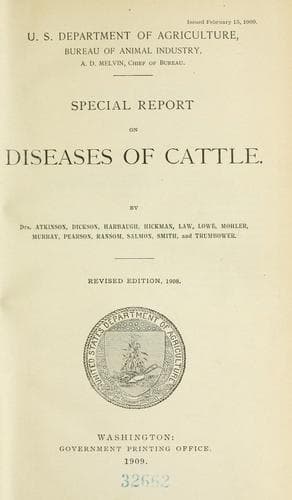
Special report on diseases of cattleUnited States. Bureau of Animal Industry
Science
Special report on diseases of cattle
United States. Bureau of Animal Industry
Cattle -- Diseases
In many cases of excess of parts the extra part or member is manifestly
derived from the same ovum, and even the same part of the ovum, being
merely the effect of a redundancy and vagary of growth. Such cases include
most instances of extra digits or other organs, and even of double
monsters, as manifested by the fact that such extra organs grow from the
normal identical organs. Hence the extra digit is attached to the normal
digit, the extra head to the one neck, the extra tail to the croup, extra
teeth to the existing teeth, and even two similarly formed bodies are
attached by some point common to both, as the navels, breastbones, backs,
etc. (Pl. XIX, figs. 1, 2, 3.) This shows that both have been derived from
the same primitive layer of the embryo, which possessed the plastic power
of building up a given structure or set of organs. An inclosed ovum, on the
other hand, has no such identity or similarity of structure to the part
with which it is connected, showing an evident primary independence of both
life and the power of building tissues and organs. The power of determining
extra growth along a given natural line is very highly developed in the
early embryo and is equally manifest in the mature examples of some of the
lower forms of animal life. Thus a newt will grow a new tail when that
member has been cut off, and a starfish will develop as many new starfishes
as the pieces made by cutting up the original one. This power of growth in
the embryo and in the lower form of animals is comparable to the branching
out again of a tree at the places from which branches have been lopped. The
presence of this vegetablelike power of growth in the embryo accounts for
most double monsters.
The influence of disease in modifying growth in the early embryo,
increasing, decreasing, distorting, etc., is well illustrated in the
experiments of St. Hilaire and Valentine in varnishing, shaking, or
otherwise disturbing the connections of eggs and thereby producing
monstrosities. One can easily understand how inflammations and other causes
of disturbed circulation in the womb, fetal membranes, or fetus would cause
similar distortions and variations in the growing fetus. It is doubtless
largely in the same way that certain mental disturbances of a very
susceptible dam affect the appearance of the progeny. The monstrosities
which seriously interfere with calving are mainly such as consist in extra
members or head, which can not be admitted into the passages at the same
time, where some organ of the body has attained extra size, where a
blighted ovum has been inclosed in the body of a more perfect one, or where
the body or limbs are so contracted or twisted that the calf must enter the
passages doubled up.
Public-domain text, read in full here on John Shaqi.
Reviews
Reviews
No reviews yet
Be the first to share your thoughts on this work.
Elsewhere in the archive
Join the Discussion
Join the discussion
Sign in to leave a comment or review.
Sign InorCreate an account