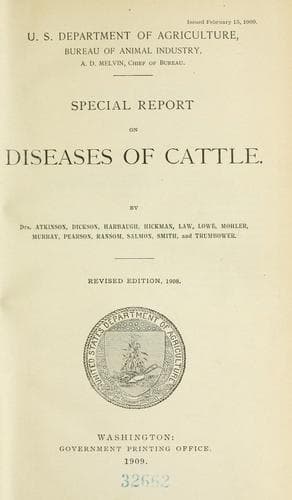
Special report on diseases of cattleUnited States. Bureau of Animal Industry
Science
Special report on diseases of cattle
United States. Bureau of Animal Industry
Cattle -- Diseases
_Causes._--The causes of monstrosities are varied. Some, like extra digits,
lack of horns, etc., run in families, which produce them with absolute
certainty when bred in the direct line, although they were originally
acquired peculiarities which have merely been fixed by long habit in
successive generations. The earliest horse had five toes, and even the most
recent fossil horse had three toes, of which the two lateral ones are still
represented in the modern animal by the two splint bones. Yet if our horse
develops an extra toe it is pronounced a monstrosity. A more genuine
monstrosity is the solid-hoofed pig, in which two toes have been merged
into one. Another of the same kind is the solid shank bone of the ox, which
consists of two bones united into one, but which are still found apart in
the early fetus. Though originally acquired peculiarities, they now breed
as invariably as color or form.
Other monstrosities seem to have begun in too close breeding, by which the
powers of symmetrical development are impaired, just as the procreative
power weakens under continuous breeding from the closest blood relations. A
monstrosity consisting in the absence of an organ often depends on a simple
lack of development, the result of disease or injury, as a young bone is
permanently shortened by being broken across the soft part between the
shaft and the end, the only part where increase in length can take place.
As the result of the injury the soft, growing layer becomes prematurely
hard and all increase in length at that end of the bone ceases. This will
account for some cases of absence of eye, limb, or other organ.
Sometimes a monstrosity is owing to the inclosure of one ovum in another
while the latter is still but a soft mass of cells and can easily close
around the first. Here each ovum has an independent life; they develop
simultaneously, only the outer one having direct connection with the womb
and being furnished with abundant nourishment advances most rapidly and
perfectly, while the inclosed and starved ovum is dwarfed and imperfect
often to the last degree.
Public-domain text, read in full here on John Shaqi.
Reviews
Reviews
No reviews yet
Be the first to share your thoughts on this work.
Elsewhere in the archive
Join the Discussion
Join the discussion
Sign in to leave a comment or review.
Sign InorCreate an account