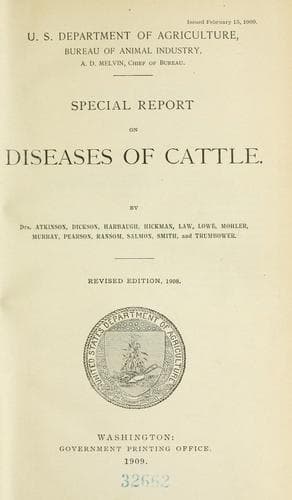
Special report on diseases of cattleUnited States. Bureau of Animal Industry
Science
Special report on diseases of cattle
United States. Bureau of Animal Industry
Cattle -- Diseases
This form of indigestion is caused by the animal gorging itself with feed,
and arises more from the animal's voracious appetite than from any defect
in the quality of the feed supplied to it. The condition is, however, more
severe if the feed consumed is especially concentrated or difficult of
digestion. In cases of this kind there is comparatively no great formation
of gas, and the gas which is formed is diffused through the stomach instead
of accumulating in a layer in its upper part. On pressing the flank with
the closed fist the indent of the hand remains for a short time in the
flank, as if the rumen were filled with a soft, doughy mass.
This form of indigestion should be treated by stimulants, such as aromatic
spirits of ammonia.
If the formation of gas is not great and the distention with solid material
is somewhat limited, the animal may be drenched through a piece of ordinary
garden hose, one end inserted in the mouth, and the other end fitted with a
funnel, giving 1-1/2 pounds of Epsom salt or Glauber's salt dissolved in 2
gallons of water, at a single dose. Immediately after this treatment the
left side of the animal, extending below the median line of the abdomen,
should be powerfully kneaded with the fist, so that the impacted food mass
will be broken, allowing the water to separate it into small portions which
can be carried downward for the process of digestion. But if the treatment
fails and the impacted or overloaded condition of the rumen continues, it
may become necessary to make an incision with a sharp, long-bladed knife in
the left flank, commencing at the point where it is usual to puncture the
stomach of an ox, and prolong the incision in a downward direction until it
is long enough to admit the hand. When the point of the knife is thrust
into the flank and the blade cuts downward, the wall of the stomach, the
muscle, and the skin should all be cut through at the same time. Two
assistants should hold the edges of the wound together so as to prevent any
food from slipping between the flank and the wall of the stomach, and then
the operator should remove two-third [sic] of the contents of the rumen.
This having been done, the edges of the wound should be sponged with a
little carbolized warm water, and, the lips of the wound in the rumen being
turned inward, they should be brought together with catgut stitches. The
wound penetrating the muscle and the skin may then be brought together by
silk stitches, which should pass through the entire thickness of the muscle
and should be about 1 inch apart. The wound should afterwards be dressed
once a day with a lotion and the animal covered with a tight linen sheet,
to protect the wound from insects and dirt. The lotion to be used in such
case is made up as follows: Sulphate of zinc, 1 dram; carbolic acid, 2
drams; glycerin, 2 ounces; water, 14 ounces; mix. It is clear that this
operation requires special skill and it should be attempted only by those
who are competent.
Public-domain text, read in full here on John Shaqi.
Reviews
Reviews
No reviews yet
Be the first to share your thoughts on this work.
Join the Discussion
Join the discussion
Sign in to leave a comment or review.
Sign InorCreate an account