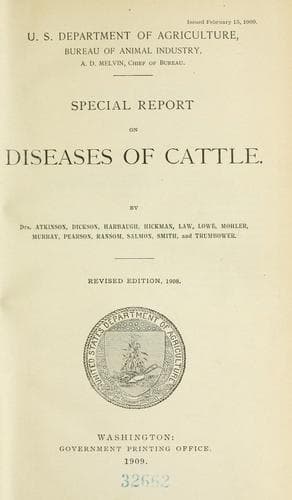
Special report on diseases of cattleUnited States. Bureau of Animal Industry
Science
Special report on diseases of cattle
United States. Bureau of Animal Industry
Cattle -- Diseases
_Cause._--The cause of this disordered state of the digestive system in
cattle is usually obscure, but has in some cases been traced to a partial
closure of the opening into the second stomach or to a distention of the
esophagus. It has been found to occur when there was cancerous disease of
the fourth stomach, and experimentally it has been shown that a suspension
of digestion or great derangement of this stomach produces considerable
nervous disorder of the rumen and sometimes vomiting or attempts to vomit.
TREATMENT.--Easily digested feed and plenty of water should be given. Fear
and excitement, chasing, or hurrying animals after they have eaten heartily
are liable to bring on this result. In order to overcome irritation which
may produce vomiting the following draft should be given: Hydrate of
chloral, half an ounce; water, 1 pint. The dose must be repeated when the
condition of the animal seems to require it. As a rule, treatment is not
successful.
DEPRAVED APPETITE (PICA).
Cattle suffering from this disease have a capricious and variable appetite
as regards their ordinary feed but evince a strong desire to lick and eat
substances for which healthy cattle show no inclination. Alkaline and
saline-tasting substances are especially attractive to cattle having a
depraved appetite and they frequently lick lime, earth, coal, gravel, and
even the dung of other cattle. Cows in calf and young cattle are especially
liable to develop these symptoms. Animals affected in this way lose
condition, their coat is staring, gait slow, and small vesicles containing
yellow liquid form under the tongue; the milk given by such cows is thin
and watery. Such animals become restless and uneasy, as is indicated by
frequent bellowing. The disease may last for months, the animal ultimately
dying emaciated and exhausted. Depraved appetite frequently precedes the
condition in which the bones of cattle become brittle and fracture easily,
which is known as osteomalacia.
_Cause._--From the fact that this disease is largely one of regions, it is
generally believed that some condition of the soil and water and of the
local vegetation is responsible for it. It is more prevalent some years
than others, and is most common in old countries, where the soil is more or
less depleted. Cattle pastured on low, swampy land become predisposed to
it. It occasionally happens, however, that one individual in a herd suffers
though all are fed alike; in such cases the disease must arise from the
affected animal's imperfect assimilation of the nutritive elements of the
feed which is supplied to it.
Public-domain text, read in full here on John Shaqi.
Reviews
Reviews
No reviews yet
Be the first to share your thoughts on this work.
Join the Discussion
Join the discussion
Sign in to leave a comment or review.
Sign InorCreate an account