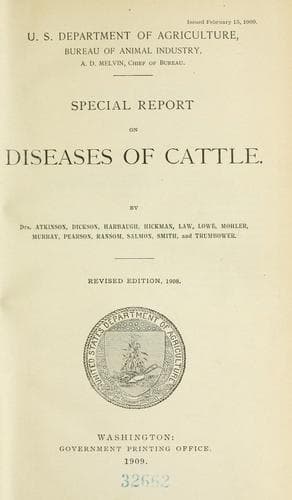
Special report on diseases of cattleUnited States. Bureau of Animal Industry
Science
Special report on diseases of cattle
United States. Bureau of Animal Industry
Cattle -- Diseases
ABSCESS OF THE NAVEL.
As the result of irritation at calving or by the withered cord, or by
licking with the rough tongue of the cow, inflammation may attack the loose
connective tissue of the navel to the exclusion of the urachus and veins,
and go on to the formation of matter. In this case a firm swelling appears
as large as the fist, which softens in the center and may finally burst and
discharge. The opening, however, is usually small and may close
prematurely, so that abscess after abscess is formed. It is distinguished
from hernia by the fact that it can not be returned into the abdomen, and
from inflammations of the veins and urachus by the absence of swellings
forward and backward along the lines of these canals.
Treatment consists in an early opening of the abscess by a free incision
and the injection twice a day of an astringent antiseptic (chlorid of zinc
one-half dram, water 1 pint).
INFLAMMATION OF THE NAVEL VEINS (UMBILICAL PHLEBITIS).
In this affection of the navel the inflammation may start directly from
mechanical injury, as in either of the two forms just described, but on
this are inoculated infective microbes, derived from a retained and
putrefying afterbirth, an abortion, a metritis, a fetid discharge from the
womb, an unhealthy open sore, a case of erysipelas, from overcrowding, from
filthy floor or bedding, or from an offensive accumulation of manure, solid
or liquid. As the microbes vary in different cases, given outbreaks will
differ materially in their nature. One is erysipelatoid; another purulent
infection with the tendency to secondary abscesses in the joints, liver,
lungs, etc.; another is from a septic germ and is associated with fetid
discharge from the navel and general putrid blood poisoning. In estimating
the causes of the disease we must not omit debility of the calf when the
mother has been underfed or badly housed or when either she or the fetus
has been diseased.
_Symptoms._--The symptoms vary. With the chain-form germs (streptococci)
the navel becomes intensely red, with a very firm, painful swelling, ending
abruptly at the edges in sound skin and extending forward along the
umbilical veins. The secondary diseases are circumscribed, black
engorgements (infarctions) or abscesses of the liver, lungs, kidneys,
bowels, or other internal organs, and sometimes disease of the joints.
With the ordinary pus-producing germs (_Staphylococcus pyogenes aureus_ and
_Streptococcus pyogenes_) the local inflammation in the navel causes a hot,
painful swelling, which rapidly advances to the formation of matter (pus),
and the raw, exposed surface, at first bright red, becomes dark red or
black, soft, friable, and pultaceous. If the pus is white, creamy, and
comparatively inoffensive in odor, the secondary formations in internal
organs and joints are mainly of the same purulent character (secondary
abscesses).
Public-domain text, read in full here on John Shaqi.
Reviews
Reviews
No reviews yet
Be the first to share your thoughts on this work.
Elsewhere in the archive
Join the Discussion
Join the discussion
Sign in to leave a comment or review.
Sign InorCreate an account